
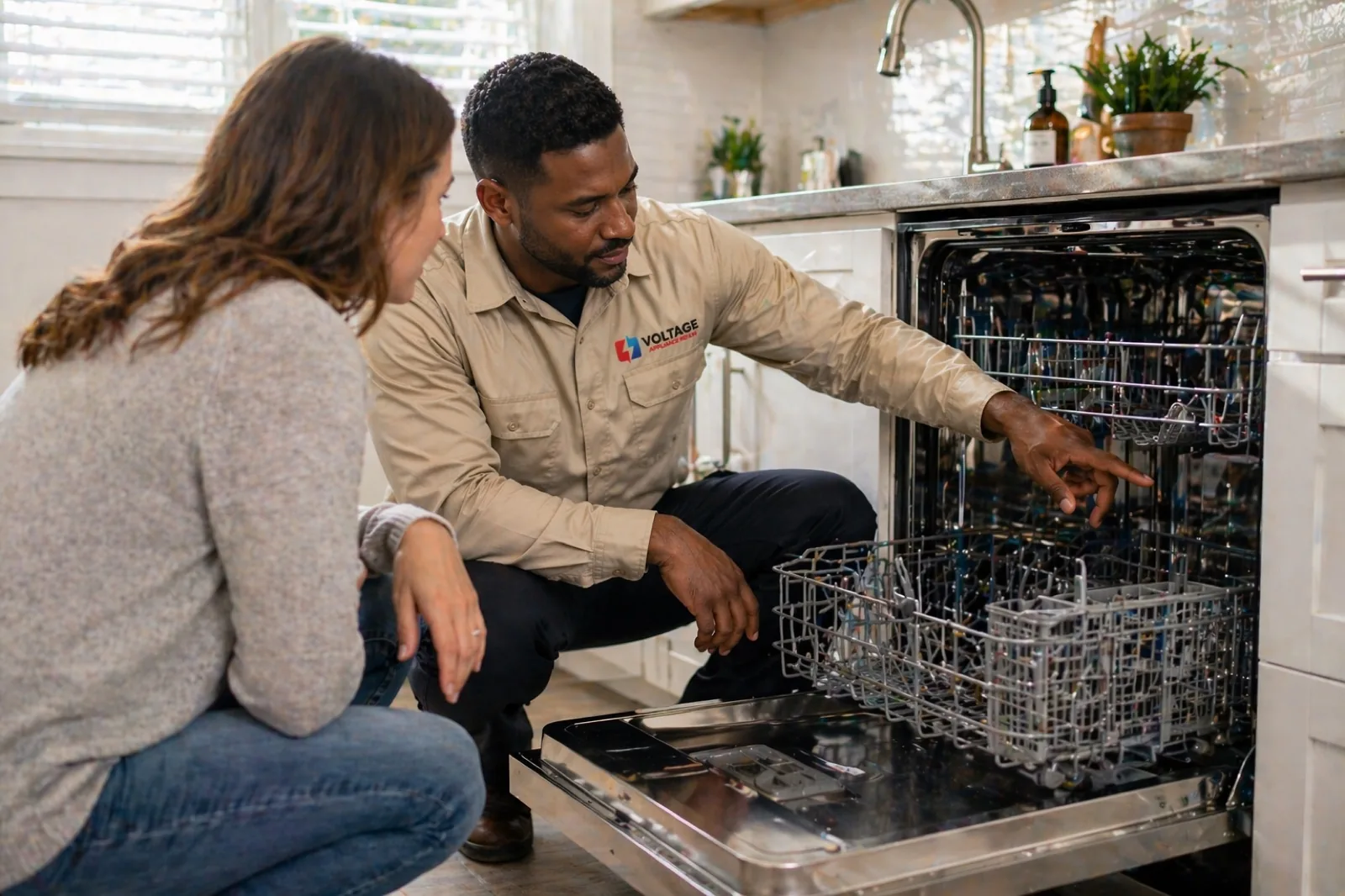
Standing water at the bottom of your dishwasher is frustrating. It also looks worse than it usually is. Before you assume the worst, work through these four checkpoints in order. Most calls we get on this issue are resolved by the first or second item on this list.
1. The Filter
Start here. Always start here.
Most modern dishwashers have a removable cylindrical filter at the base of the tub — usually near the spray arm. If it hasn't been cleaned in a few months, it's probably clogged with food debris, grease, and mineral buildup.
Twist it out. Rinse it under warm water. Use a soft brush if there's visible gunk. Reinstall it and run a short cycle.
That fix alone covers a significant share of "won't drain" calls. No tools, no parts, three minutes.
2. The Drain Hose
The drain hose runs from the pump to either your garbage disposal or the sink drain under the counter. It can fail in two ways.
Kinked. Pull the dishwasher slightly forward and look behind it. A sharp bend in the hose blocks water just like a pinched straw. Straighten the loop, reposition the machine, run a test cycle.
Clogged. Grease and food particles can build up inside the hose over time. Disconnect it from the disposal end (have a towel ready) and blow through it or flush it with water. If nothing moves, the hose needs replacement. They're inexpensive.
Together, a blocked filter and a bad hose account for roughly 80% of dishwasher drainage failures. If you clear both and water still sits at the bottom, move to step three.
3. The Garbage Disposal Connection
If your dishwasher drains into a garbage disposal, this is the next thing to check — and it's one people miss.
When a new disposal is installed, there's a knockout plug inside the dishwasher inlet port. If whoever installed it forgot to remove that plug, water has nowhere to go. It's a one-time factory plug, and it catches even experienced plumbers off guard.
Run your garbage disposal before starting a wash cycle. If there's a blockage inside the disposal itself, it backs water up into the dishwasher tub. Clear the disposal, check that the inlet port is open, and test again.
4. The Drain Pump
This is the 20% scenario — and it's a real repair, not a DIY fix.
The drain pump is the motor that actively pushes water out of the machine. When it fails, nothing drains, no matter how clear the hose and filter are. You may hear a humming sound with no movement, or complete silence when the drain cycle should be running.
Pump failures usually come from one of three things: a small foreign object (a bone fragment, a broken piece of glass) jamming the impeller; a motor winding that's burned out; or worn bearings that finally gave.
A pump replacement is a straightforward single-visit repair — but only if the technician arrives with the correct part. That means diagnosing the brand and model before the visit, not during it. A Bosch pump is not a Whirlpool pump. Same symptom, different part.
This is why a proper diagnosis call matters before any repair order is placed.
What the Order Tells You
Work through it this way:
- Filter — clean it yourself, five minutes
- Drain hose — inspect for kinks or clogs, fifteen minutes
- Garbage disposal connection — check knockout plug and run the disposal
- Drain pump — call a tech if the first three are clear
If you've been through all four and water still won't move, the pump is almost certainly the answer. At that point the job needs a real technician with the right part on the truck.
We repair dishwashers across Miami-Dade and Broward — LG, Bosch, Miele, KitchenAid, Thermador, Samsung, and most other brands. Same-day visits available when you call before 2 PM. Reach us at 786-869-3888.