Voltage Appliance Repair Call 786-869-3888
Same-day washer repair · Broward & Miami-Dade

Same-Day Washer Repair.
Broward & Miami-Dade.

Won't drain, spin, or start? We'll have the laundry moving again today. Our techs arrive with parts in the van for every major brand — most washer repairs finish in one visit.
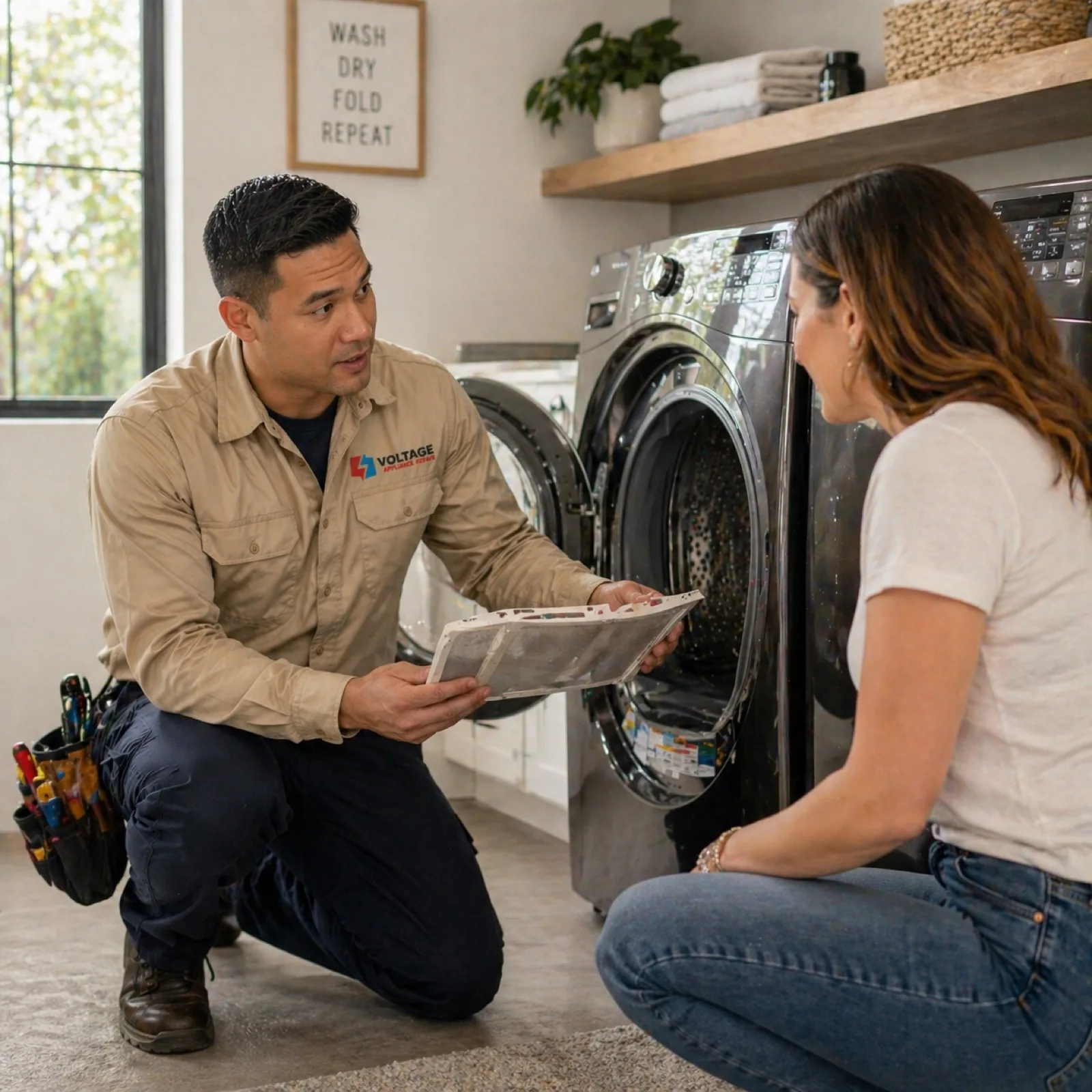
Licensed & Insured Same-day service Parts & labor warranty
Washer Repair by Voltage Appliance Repair
Washer specialists
Today
Same-day · when available
$75
Flat diagnostic fee
7d
Open every day
24hr
Most calls handled in
Common washer issues

Sound familiar? We see it daily.

If your washer is doing any of these, don't wait for it to get worse. Same-day diagnostic, flat $75 fee, honest quote before any work starts.

Won't drain water
Won't spin the drum
Leaking from the bottom
Loud banging or shaking
Won't start at all
Error codes on display
Water won't fill
Brands we service

All major and luxury brands.

LGSamsungGEWhirlpoolKitchenAidMaytagBoschFrigidaireKenmore
Why Voltage

Real techs. Real trucks. Real parts.

$75

Upfront diagnostic

Flat, honest fee. Quote before any work starts.

1x

One visit, usually

Common parts for every major brand are already on the truck.

7d

Open every day

Monday–Sunday. Your washer breakdown does not wait for a weekday.

100%

Warrantied work

Parts and labor covered.

Service areas

Washer Repair across Broward & Miami-Dade.

From the van · Washer

What actually breaks in a washer.

Most washer failures are small parts giving out under load. The repeat offenders: a drain pump or filter blocked by coins, hairpins, and lint; a door lock or lid switch that no longer confirms the machine is closed; a worn drive belt or shift actuator on a top loader; and inlet valve screens choked with the mineral scale South Florida's hard water leaves behind. What people assume is broken usually is not. Homeowners tell us the motor is dead or the board is fried, and far more often the motor is fine while a switch, a pressure sensor, or a corroded connector feeds the board bad information. Boards do fail, since a garage washer takes heat, humidity, and salt air year round and storm-season power sags are hard on electronics, but a board gets diagnosed last, not first. What actually ends a washer is the tub side: a rear drum bearing sealed inside the outer tub, or a cracked spider arm on a front loader. At that point parts and labor pass what the machine is worth.

Common problems we fix

Washer symptoms, diagnosed honestly.

Two different problems land here, and drainage is the one to rule out first. If the pump filter, the pump impeller, or the drain hose is restricted, the tub never empties, and the control will not ramp into high spin while the pressure switch still reads water. The other cause is mechanical: worn shock absorbers on a front loader or tired suspension rods on a top loader let the tub knock as the drum speeds up, so the control drops back to a slow spin to protect the cabinet and the load stays heavy. We pull the filter and check pump flow first, because a coin or a mat of lint in the impeller is the cheap answer and it shows itself in a couple of minutes. If the machine drains clean, we check the shocks or rods for lost damping and replace them as a full set rather than one at a time, then rebalance the tub. Pumps and shock sets for common platforms ride on the van, so this normally finishes in one visit.
Often the lock itself is fine. Many door locks are thermally actuated and stay engaged for a minute or two after the cycle ends while the element cools, and the control also holds the door shut for as long as the pressure switch reads water in the tub, so a restricted drain shows up as a stuck door. A failed lock assembly, the solenoid and switch unit in the door frame, is what is left once the tub is empty and that delay has passed. We check drainage and the pressure system before condemning anything, then replace the lock assembly if the switch contacts and the wiring at the connector confirm it. Before we leave, the machine runs a full cycle so you watch the door release on its own instead of taking our word for it.
The water inlet valve is no longer sealing. It is a solenoid-operated diaphragm valve, and mineral grit from hard water works under the diaphragm or scores the seat, so line pressure keeps pushing water past it with the machine sitting idle. There is an easy confirmation: if the drum still fills with the washer unplugged, the valve is stuck open mechanically and the control board has nothing to do with it. The first thing we do is shut the hot and cold valves at the wall so nothing keeps filling while we work. The valve and the inlet screens are parts we carry, so the valve gets swapped on the same trip and the screens get cleaned or replaced, which is what keeps the new valve from failing the same way.
The rear drum bearing has failed, usually after the rear tub seal started weeping and let wash water reach it. Before we call it, we rule out the cheaper look-alike, since a coin, an underwire, or a bra hook trapped between the inner drum and the outer tub makes a similar racket. A bearing is a low roar that rises and falls with drum speed, and you can feel play when you rock the drum at the rear by hand. On most residential front loaders the bearings are pressed into a sealed outer tub and are not sold apart from it, so the honest repair is a tub-and-bearing assembly with a new seal, plus hours of labor to get in and back out. We show you the worn part with the machine open and tell you straight whether that makes sense on your washer or whether replacement is the better call.
Biofilm grows wherever water sits between loads: the folds of the door boot, the detergent drawer and its siphon cap, and the pump filter housing, which is built to hold water by design. Cold cycles and too much detergent feed it, and in South Florida a washer in a closed laundry closet never fully dries out between loads, so it comes back faster here. We pull and clean the pump filter and its housing, the drain hose, the drawer and drawer cavity, and the boot, and we replace the boot when it is torn or stained through. After that it comes down to routine: leave the door and the drawer cracked open, run a hot tub-clean cycle now and then, and cut the detergent back, because excess suds are what feeds the film.
Check the drain hose for a kink and the pump filter for debris (coins and socks are classics). If those are clear, the drain pump or its control has failed — that's our territory, and it's usually a one-visit repair. Read the full guide
A stretched or broken drive belt, worn motor coupling, a failed lid switch, or a control fault — depends on the model and symptoms. If it fills and agitates but won't spin, the diagnosis is usually quick. Read the full guide
Could be as simple as a loose drain-pump clamp or as serious as a cracked outer tub. Shut off the water, stop running it, and have it looked at — continued running can flood the laundry room and burn out the pump motor.
Worn shock absorbers or suspension springs are the usual cause on front-loaders; an unbalanced or overloaded drum on top-loaders. If it's new behavior on every load, the suspension needs service before it damages the tub bearings. Read the full guide
Check the outlet and breaker first. If power's fine, it's typically the door-lock assembly, the start switch, or the main control board. We test each in order — no guessing, no parts-cannon.
Each brand has its own code map — LG's OE is a drain fault, Samsung's UE is unbalance, Whirlpool's F-codes point to specific components. Tell us the code when you call and the tech arrives with the likely part already on the truck.
Usually the inlet valve screens are clogged with sediment, the water-inlet valve has failed, or the pressure switch mis-reads the level. All are same-visit repairs with parts we stock.
What customers say

Trusted by neighbors across South Florida.

From the blog

Repair advice from our techs.

FAQ · Washer Repair

Straight answers before you book.

Yes, and the machines do not leave the closet. A stacked pair gets separated so the washer can slide forward far enough to reach the pump, the boot, and the back of the tub, and the stack goes back together the way we found it before we leave. Clearing whatever is stored on top of and around the pair, and leaving a path from the door, is the one thing that saves real time on a closet install.
Different in where it fails, not in whether we work on it. A direct-drive front loader has no belt or transmission, so the parts that come up are the door lock, the drain pump, the rotor position sensor, and the connections at the stator, and it usually names the fault with a code on the display. A belt-driven top loader fails on the mechanical side instead, the belt, the shift actuator, the lid switch, the clutch, and it gives you no code at all, so that one gets diagnosed by hand, whether the badge says Whirlpool, Maytag, LG, Samsung, GE, or Electrolux.
The line is not the machine's age, it is where the failure sits. Anything reachable from the front panel or the back panel is a bolt-on part with a normal amount of labor behind it, and on a washer that otherwise runs well that work is worth doing, with parts and labor warrantied. Once the job requires splitting the outer tub, for a drum bearing or a corroded spider arm, the labor alone reshapes the decision, and you get that answer with the machine open and the worn part in front of you rather than as a guess over the phone.
Write down any error code on the display first, since it disappears the moment you cut power and it tells the tech where to start. Leave the door shut if the tub still holds water: on most front loaders there is a short drain-down hose beside the pump filter behind the lower access panel, so put a shallow pan under it and let the tub down in stages before anyone tries to open anything. Once the tub is empty you can shut both supply valves and unplug the machine, and if you reach us before 2 PM the same day is usually available.
Most washer repairs are completed in one visit. Diagnostic takes 20-30 minutes; the fix itself depends on the issue, usually 1-2 hours.
Flat fee for a licensed tech to inspect the appliance and give you an upfront repair quote. No hidden charges.
Yes. We specialize in Sub-Zero, Viking, Thermador, Wolf, Miele, Bosch and other luxury brands — and built-in configurations.
We'll tell you honestly if replacement is the smarter move. No incentive to push repairs that don't make sense.
Yes — parts and labor. OEM parts where appropriate so the fix lasts.

Let's get it fixed today.

Pick up the phone or book online. We'll confirm your time window within minutes.
Open 7 days · Mon–Fri 8a–8p · Sat–Sun 8a–5p
Palm Beach — 4 trucks Broward — 8 trucks live Miami-Dade — 4 trucks live
Call now Book