
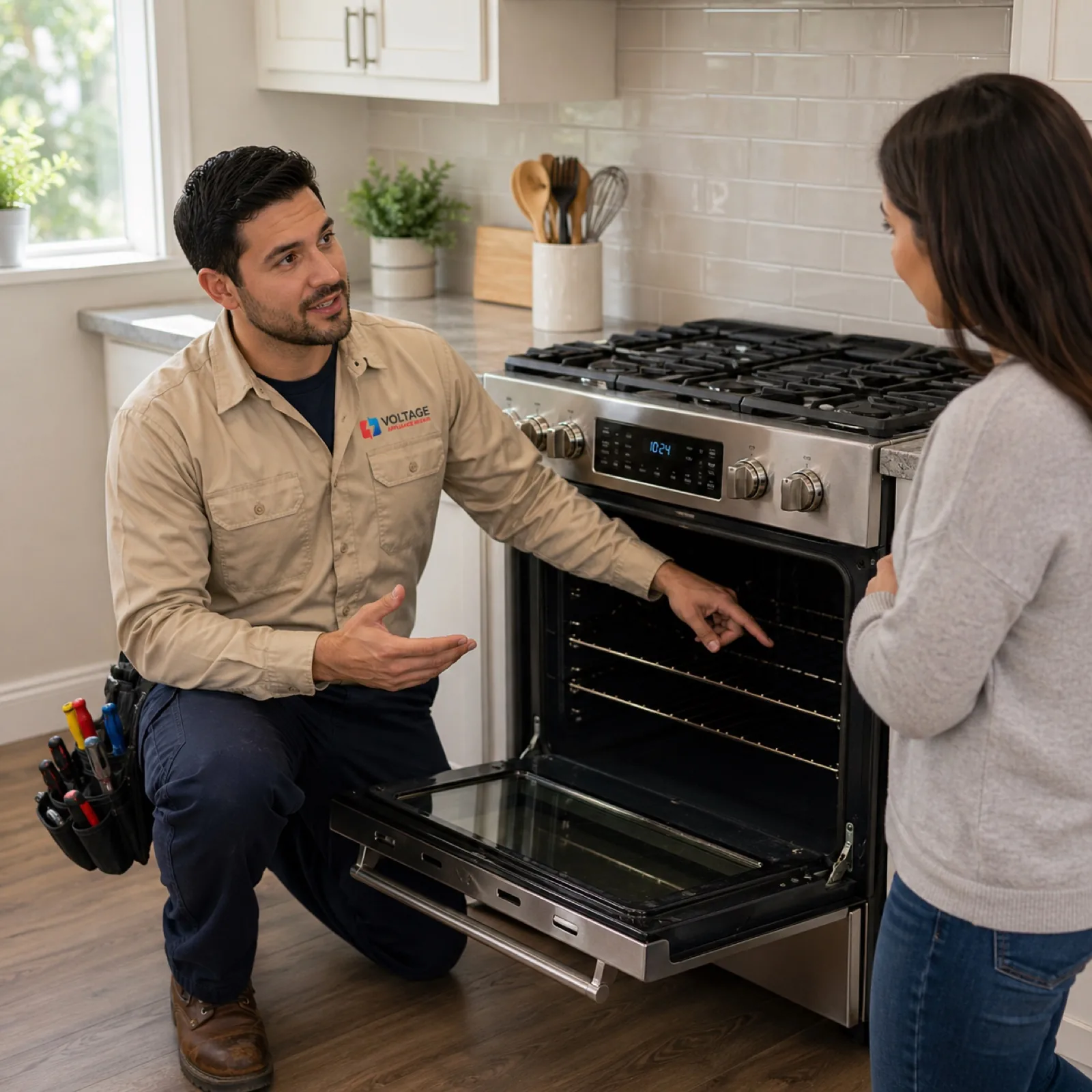
You pull a sheet pan out of the oven. One side is perfect. The other side is pale. The bottom is burnt and the center is still raw. You rotate pans, adjust racks, blame the recipe. The oven is the problem.
Uneven baking has three main causes. Most of the time it's one of them. Here's how to tell which.
Dealing with this right now? A free service call with your repair gets you an honest answer — fix it or skip it, quoted upfront. Call 786-869-3888 · same-day across Broward & Miami-Dade.
1. The Bake Element Is Failing (Visible Glow Check)
On electric ovens, the bake element lives at the bottom of the cavity. It's the curved metal rod that glows red when the oven is on. When it's healthy, it glows evenly — tip to tip, same brightness, no dark spots.
When it's failing, you'll see one of these:
- A section that stays dark while the rest glows
- A visible crack, blister, or burn mark on the element itself
- The element glowing only at the ends, dimly, then cutting out
The test: Set the oven to 350°F and watch the element through the window for the first two minutes. Don't open the door. You want to see a full, even red glow from the entire element. If part of it stays cold — or you see arcing or sparking — the element is failing and needs to be replaced.
A weak element can't maintain floor-level heat. Food bakes from the top only. Bottoms stay pale. Cakes sink in the middle. That's the signature.
2. The Hidden Bake Element Isn't Cycling Correctly
Newer ovens — GE, Samsung, LG, and most ranges made after 2015 — hide the bake element under the oven floor. You can't see it. This is intentional: it keeps spills off the element and makes the cavity easier to clean.
The tradeoff is that you lose the visual glow check. The floor of the oven radiates heat upward through a ceramic or porcelain panel. When the hidden element is failing, the symptom is subtler — uneven floor heat, hot spots toward the back or front, longer-than-normal preheat times.
The test: Use an oven thermometer. Place it on the center rack. Preheat to 350°F and let the oven stabilize for 20 minutes. Read the thermometer. Then move it: front left, back right, front right, back left. If readings vary by more than 25°F across positions, you have uneven floor heat. A hidden element fault is likely.
You can also pull the oven floor panel (it usually just lifts out) and inspect the element directly for cracks or burn marks. Always unplug the oven first.
3. The Convection Fan Isn't Moving Air
If your oven has a convection mode, it uses a rear-mounted fan to circulate hot air evenly around the cavity. Even distribution of air = even browning on all sides.
A failing convection fan doesn't always stop completely. More often it slows down, runs intermittently, or wobbles because a blade is bent or the motor is weakening. The result: uneven browning that looks worse on one side of the pan — because that side is getting less airflow.
The test: Set the oven to convection bake at 350°F. Stand at the door and listen for a steady fan hum from the back of the oven. Then open the door briefly — you should feel a noticeable movement of air across the back wall. If the fan sounds like it's struggling, grinding, or intermittent, the motor or blade is the issue.
A simple paper test: hold a small piece of paper near the back of the oven with the door open and the fan running. Healthy convection pulls the paper toward the back. Weak airflow leaves it flat.
Why the Temp Sensor Is Rarely to Blame
YouTube will tell you to replace the temperature sensor. It's a $20 part and an easy video to make. But here's the reality: a failing temp sensor affects calibration, not distribution. If the sensor is off, your oven runs 15–25°F hotter or colder than set — everything bakes too fast or too slow, uniformly.
Uneven baking — one side brown, one side pale, bottom burnt while the top is fine — isn't a calibration problem. It's a heat source or airflow problem. The sensor is rarely involved.
Replace the sensor if your oven consistently overbakes or underbakes across the entire rack. Don't replace it when the problem is spatial.
The Short Version
- Visible glow not even → bake element
- Hidden-element oven with floor heat inconsistency → element under the panel
- One side of every pan comes out different → convection fan
Test before you guess. Most of the time, one of these three parts is the answer.
If you've run through the checks and still aren't sure what you're looking at — or if you found a crack, a burnt spot, or a motor that won't spin — that's the right time to call. We carry common elements and convection motors on the truck. Same-day visits available when you call before 2 PM. (786) 869-3888.