
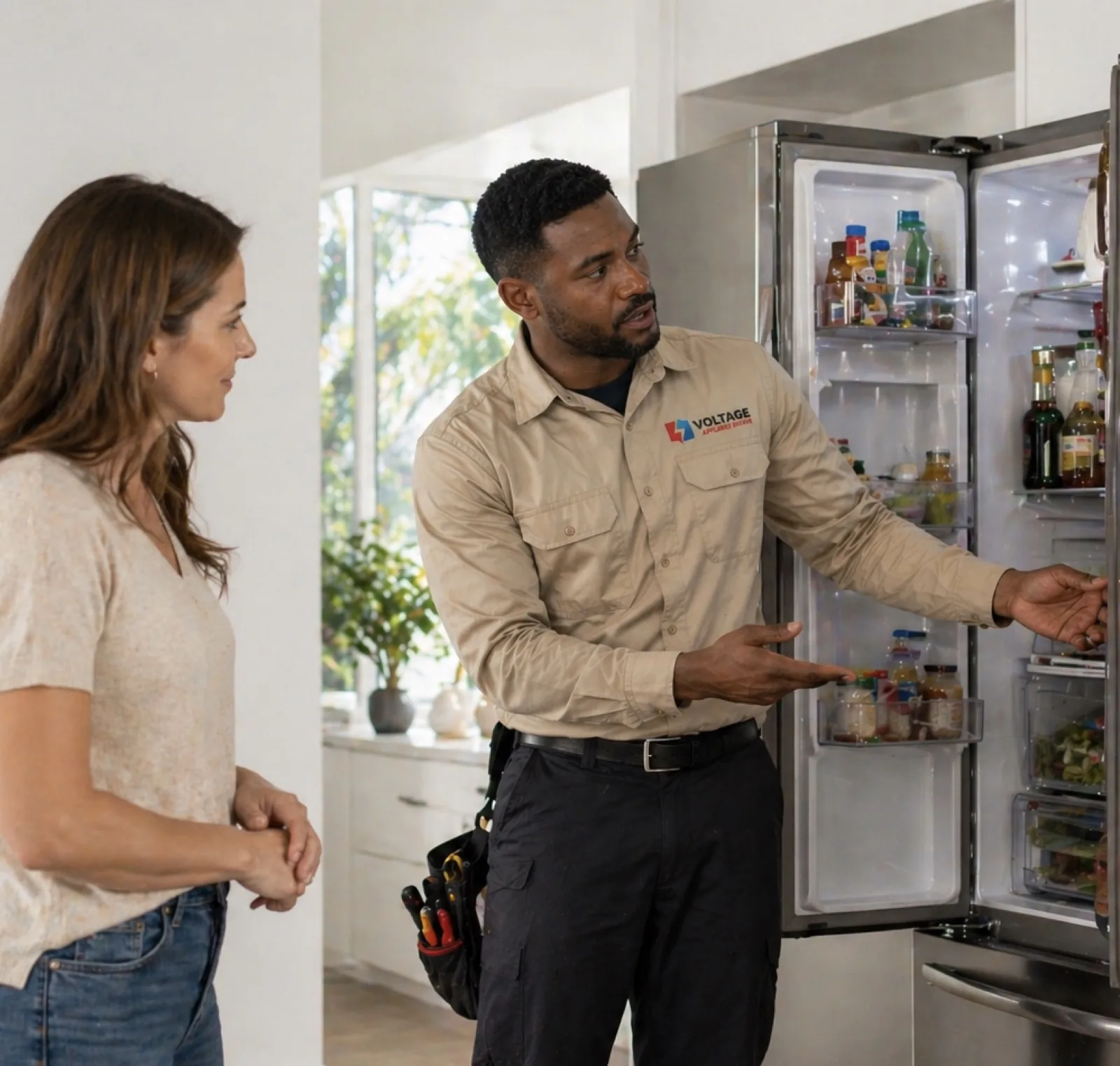
Your lettuce is frozen solid. Your leftovers have ice crystals. But the produce drawer at the bottom is perfectly fine. If this is your Samsung refrigerator, you're not imagining things — and it's not a fluke.
This is a known pattern. And it has a specific cause.
Dealing with this right now? A free service call with your repair gets you an honest answer — fix it or skip it, quoted upfront. Call 786-869-3888 · same-day across Broward & Miami-Dade.
The Symptom Is Predictable
Samsung French door and side-by-side models with TWIN Cooling Plus systems develop a consistent failure mode: the top shelf of the fresh food compartment freezes while lower shelves stay at normal temperature. Food near the back freezes first. Drinks get slushy. Eggs crack.
The thermostat reads normal. The fridge isn't "too cold" globally. Just one zone. Just the top.
That's the clue.
What's Actually Happening
Samsung's TWIN Cooling system uses a dedicated damper — a small motorized flap — to regulate how much cold air flows from the freezer side into the fresh food compartment. When this damper fails, it gets stuck open.
Cold air pours in continuously. It sinks from the top vent down. The top shelf takes the full blast. The bottom shelves, further from the vent, stay relatively normal.
The damper isn't acting alone, though. The control board tells the damper when to open and when to close. In a range of Samsung models built between 2017 and 2022, firmware bugs cause the board to misread sensor data — specifically, it can fail to register that the compartment has reached target temperature. So it keeps the damper open. Indefinitely.
The result: the damper is stuck open because the board told it to stay there.
Why This Gets Misdiagnosed
Most homeowners — and some technicians — go straight for the thermostat or the temperature sensor. Both will test fine. Because both are fine.
The failure is in the communication between components. The sensor sends an accurate reading. The board misinterprets it. The damper obeys the bad instruction.
If you replace the sensor, nothing changes. If you replace the damper motor without testing the board's command signal, the new damper will behave exactly like the old one.
You've replaced a $45 part. The problem is still there.
The Right Way to Test It
A trained tech will use a refrigerant-grade multimeter to test the damper actuator directly — checking resistance, continuity, and the actual voltage signal the board is sending under live conditions. That last part is critical.
If the board is sending a continuous "open" signal when it should be cycling, the board is the issue. If the board is cycling correctly but the damper isn't responding, the actuator is the issue.
Two different repairs. One of them costs significantly more than the other. You don't want to guess.
The Control Board Trap
Samsung control boards for refrigerators can run several hundred dollars at retail. They're a real repair — labor plus the part. Before any board gets ordered, a proper diagnosis should rule out:
- Damper actuator failure (motor seized or shorted)
- Thermistor wiring harness issues (loose connection near the evaporator)
- Firmware-correctable behavior on eligible models (Samsung has released service updates for some affected units)
In some cases, the fix is a new actuator and a firmware flash — not a full board replacement. That difference is worth knowing before you authorize the repair.
What You Should Do Now
Stop adjusting the temperature setting. It won't fix a stuck damper. Cranking the fridge warmer just means your bottom shelves lose their chill while the top keeps freezing.
Don't unplug and replug hoping for a reset. Some units recover temporarily — the damper unsticks — but the root cause remains. It will happen again.
Get a tech out who knows Samsung TWIN Cooling architecture specifically. The diagnosis on these units isn't hard if you have the right tester and the right service bulletin. It's very hard if you're guessing.
The Bottom Line
A Samsung fridge freezing only the top shelf is a damper-and-board communication failure. Not a thermostat. Not user error. A real mechanical and firmware issue that Samsung acknowledged across a wide range of model years.
The repair is straightforward when diagnosed correctly. The repair gets expensive when it isn't.
Know what you're dealing with before anything gets replaced. That's the job.