
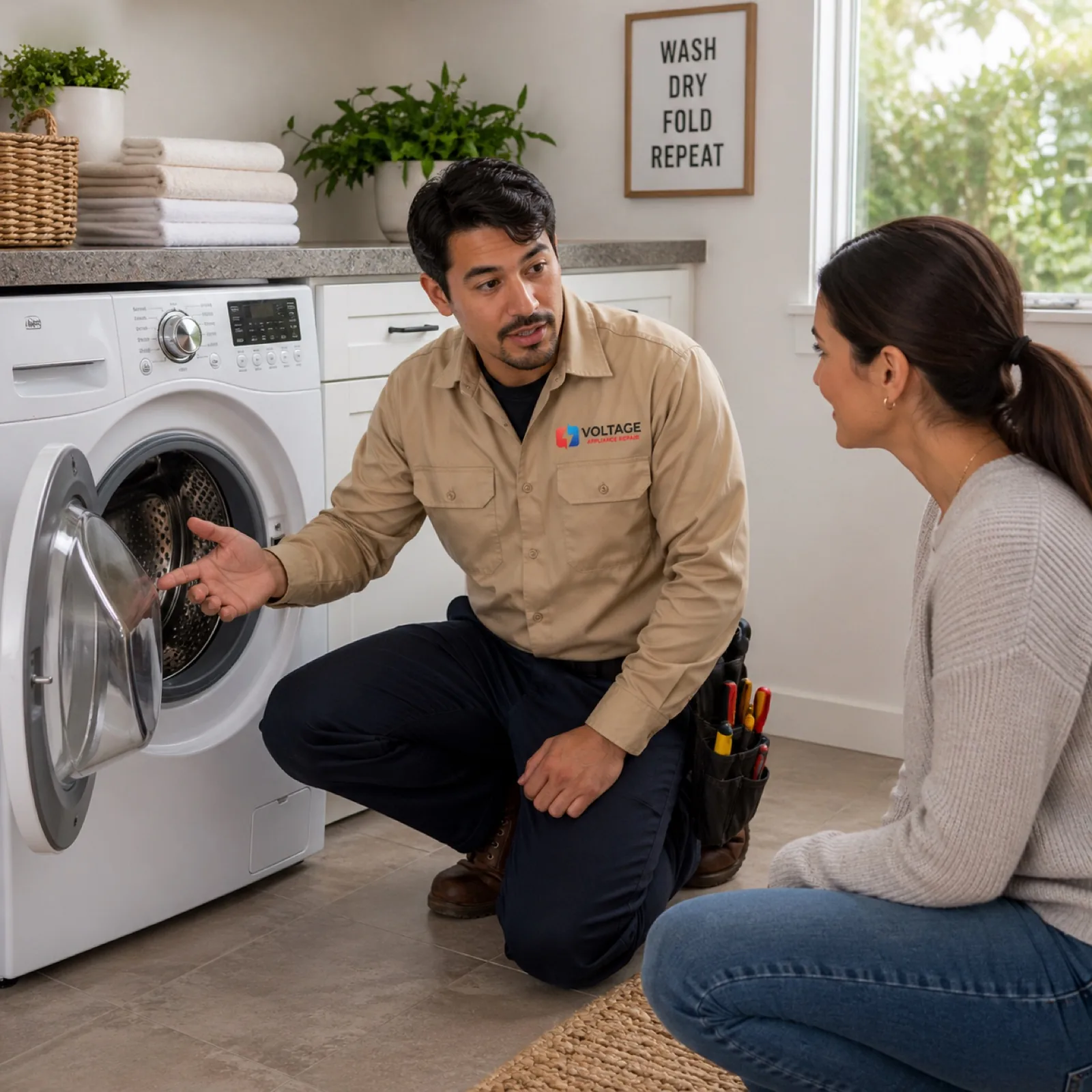
Your dryer runs a full cycle. You open the door. Everything is still damp.
You run it again. Clothes come out warm but not quite dry. You do the math: one load, two cycles, twice the electricity. Something is wrong.
Dealing with this right now? A free service call with your repair gets you an honest answer — fix it or skip it, quoted upfront. Call 786-869-3888 · same-day across Broward & Miami-Dade.
The good news? Nine times out of ten, the fix is straightforward. The bad news? Most people look in the wrong place first.
The Lint Trap Is Not the Problem
Everyone's first instinct is the lint trap. Clean it out, run another cycle, hope for the best. And yes — you should clean it after every load. But a clogged lint trap is rarely what causes a two-cycle dryer problem.
The trap catches surface lint. The deeper issue builds up somewhere else.
The Real Culprit: Your Dryer Duct
Behind your dryer is a duct — usually a flexible or rigid metal tube — that runs from the back of the machine to an exterior vent on your wall or roof. That duct is where the real lint accumulates.
Over months and years, lint sticks to the walls of that duct. The opening narrows. Hot, moist air can't escape efficiently. The dryer pushes heat in, but the humidity has nowhere to go. Clothes stay damp.
This is the cause in roughly 90% of two-cycle dryer complaints.
How to check it yourself:
- Pull the dryer a few feet away from the wall.
- Disconnect the duct from the back of the machine.
- Look inside with a flashlight. If you see visible lint buildup on the walls, the duct is partially blocked.
- Go outside and find the exterior vent cover. Push the flap open with your hand. It should move freely. If it's stuck, packed with lint, or the cover is damaged — that's part of your problem too.
A short duct run (6 feet or less, straight shot to the exterior) is easy to clean yourself with a vent cleaning brush kit. A longer run, or one with multiple bends, is worth calling a professional vent cleaning service. They use rotary brushes and suction — the job takes about an hour and costs far less than a repair call.
After a proper vent cleaning, most dryers with this issue are back to one cycle per load. Done.
The Other 10%: Moisture Sensor
If the duct checks out and the problem persists, look at the moisture sensor.
Modern dryers don't run on a fixed timer. They monitor moisture levels inside the drum and shut off when clothes reach a set dryness level. The sensor is a pair of metal bars — usually visible on the inside of the drum, near the lint trap opening.
When those bars get coated with residue (dryer sheet buildup is the most common cause), the sensor misreads the load as dry before it actually is. The machine shuts off early. You open the door to damp laundry.
How to check it:
Run your finger along the metal sensor bars. If they feel waxy or coated, clean them. A cotton ball with rubbing alcohol is all you need. Wipe each bar until the cotton comes back clean. Run a test cycle.
If cleaning the sensor doesn't fix it — or if the bars look corroded or damaged — the sensor itself may need replacement. That's a repair tech call, not a DIY job.
When to Call a Vent Cleaner vs. a Repair Tech
Here's the simple breakdown:
Call a vent cleaner if:
- The duct is visibly clogged
- The exterior vent flap is stuck or packed
- Your last cleaning was more than a year ago (or never)
- Dryer performance improved after a previous cleaning and has since declined
Call a repair tech if:
- Duct and vent are clear, but the problem continues
- The dryer is making unusual sounds — squealing, thumping
- The drum isn't heating at all, not just drying slowly
- The moisture sensor is damaged, not just dirty
- The machine is cutting off mid-cycle before clothes are dry
Most two-cycle dryer issues are solved with a duct cleaning. But if you've cleared the venting and the problem is still there, the sensor or a heating component needs attention from someone who can open the machine safely.
The Short Version
Damp laundry after a full cycle means airflow is blocked or the sensor is lying to the machine. Start with the duct. Clean the sensor next. If neither works, call a tech who can go deeper.
One cycle per load is what your dryer was built for. Get it back there.
Voltage Appliance Repair serves Broward County, Miami-Dade, and Palm Beach. Same-day visits available. Call (786) 869-3888 or book online at voltagehomeservice.com.