Wolf ranges are serious equipment. Dual-stack burners. Sealed igniters. Restaurant-grade BTUs in a residential kitchen. When one burner stops lighting, the fix looks obvious. It usually isn't.
Misdiagnosis is the rule, not the exception. Here's what the three most common Wolf igniter symptoms actually mean — and why guessing costs more than diagnosing.
Dealing with this right now? A free service call with your repair gets you an honest answer — fix it or skip it, quoted upfront. Call 786-869-3888 · same-day across Broward & Miami-Dade.
Symptom 1: Click, But No Flame
The igniter fires. You hear it. Nothing lights.
Most techs reach for the igniter module and swap it. That's the wrong move. On Wolf dual-stack burners, a clicking igniter means the igniter itself is generating spark — the ignition control module is doing its job. The problem is usually upstream or downstream of the spark.
Most likely cause: moisture intrusion.
Wolf's sealed burner design traps water when the cooktop is cleaned aggressively or when a pot boils over. Water inside the igniter well kills the arc before it reaches the gas port. The igniter isn't broken. It's wet.
The right call: remove the burner cap and base, let the well dry completely — sometimes 24 to 48 hours — and test again. If the symptom returns, inspect the igniter tip for carbon fouling. Carbon buildup creates a leakage path that bleeds off the spark voltage before it can jump the gap.
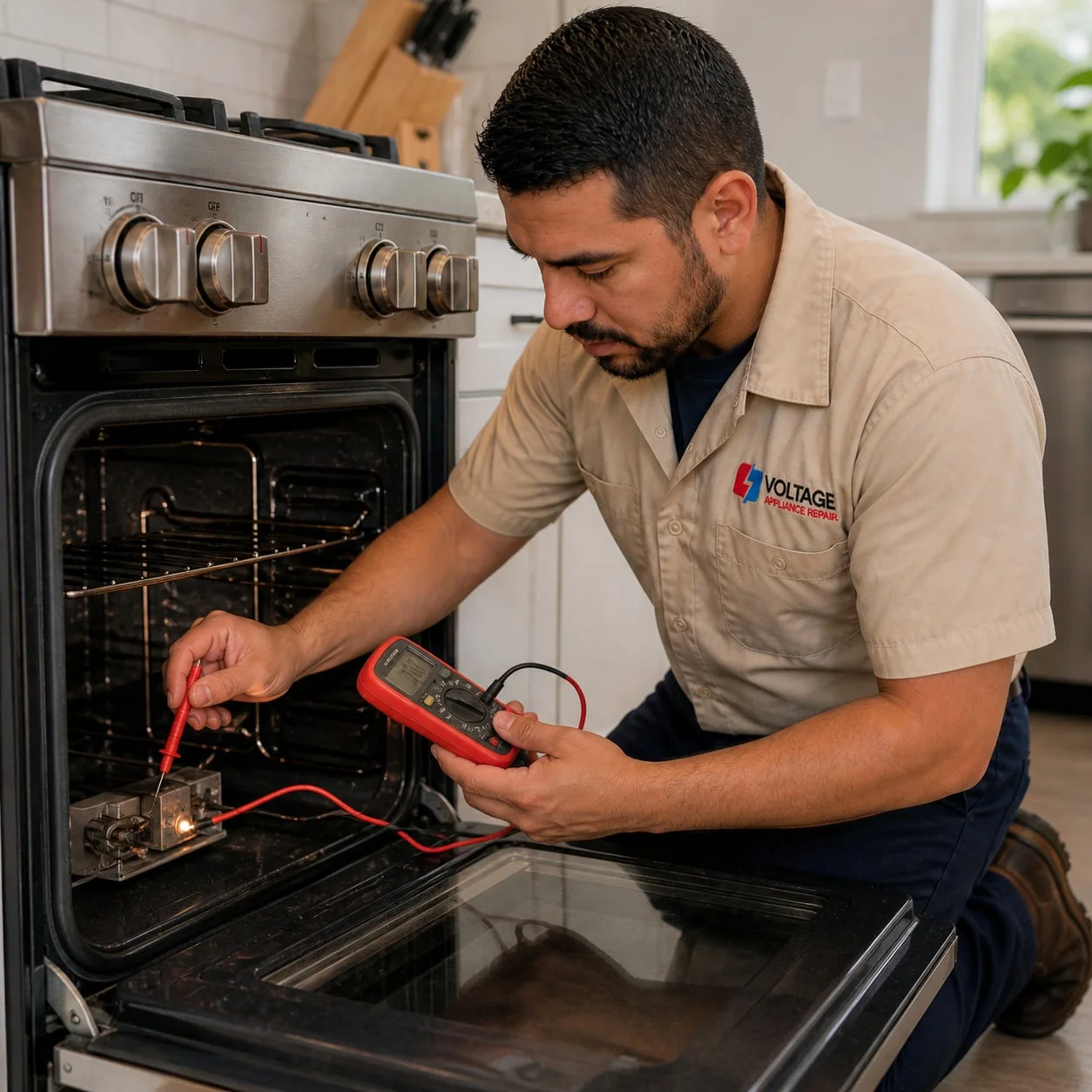
A multimeter tells you whether the igniter ceramic is intact. A voltage reading across the igniter terminals under load tells you whether the module is pushing the right output. Neither test requires a parts swap.
Symptom 2: Click With Yellow or Orange Flame
The burner lights. The flame is the wrong color.
Yellow flame on a Wolf range is not an igniter problem. It's a combustion problem. The two get confused constantly.
Most likely cause: cracked porcelain on the burner cap or a misaligned burner base.
Wolf's dual-stack design mixes primary and secondary air at two separate levels. When the porcelain cap develops a hairline crack — common after thermal cycling over years of high-heat use — the air-to-gas ratio shifts. The flame goes rich. You get yellow tips, carbon deposits, and sometimes a faint smell.
Replacing the igniter module fixes nothing here. The igniter was never involved. What's needed is a close visual inspection of the burner cap under good light, a straightedge check on the burner base seating, and a combustion air flow test.
If the porcelain is cracked, the cap needs to be replaced. If the base is warped from heat stress, the same. Neither is expensive. But diagnosing it correctly first is what makes the repair stick.
Symptom 3: No Click at All
Silence when you turn the knob. No spark. No attempt.
This one gets over-complicated fast. The temptation is to blame the ignition control module — a $200+ part on Wolf equipment. That's the last thing to replace, not the first.
Most likely cause: voltage drop or a broken wire at the igniter terminal.
Wolf ranges run all burner igniters off a single control module. If one burner won't click but the others do, the module is fine. Something is interrupting the circuit between the module and that specific igniter. Start at the terminal connection. The wiring harness on Wolf ranges routes through tight channels near the burner bases, and those channels get hot. Insulation brittles. Terminals corrode.
A continuity test on the igniter wire takes two minutes. A resistance check on the igniter itself takes another two. If resistance reads out of spec — Wolf's service documentation gives you the range — the igniter ceramic is failed and needs replacement. If resistance is in spec, you have a wiring or connection issue.
If all burners fail to click simultaneously, then and only then do you look at the module. And before you replace it, you verify incoming line voltage. A voltage drop at the range — caused by a failing breaker or undersized circuit — will kill the entire ignition system before the module fails on its own.
Why Wolf Igniter Repairs Go Wrong
Parts are cheap relative to a Wolf range. That creates bad habits. A tech who swaps an igniter module on a "no click" complaint and sends the invoice hasn't diagnosed anything. If the symptom comes back — and it will, because the root cause is still there — the customer pays twice.
Wolf's sealed burner system is designed around precision tolerances. It rewards technicians who read resistance specs, check voltage under load, and inspect porcelain before ordering parts. It punishes guesswork.
The right tool for a Wolf range igniter problem is a multimeter and the correct service documentation. Not a parts catalog.
If your Wolf burner is clicking without lighting, flaming yellow, or silent — call us. We work from the spec, not from assumptions. Same-day visits available. Call (786) 869-3888.