
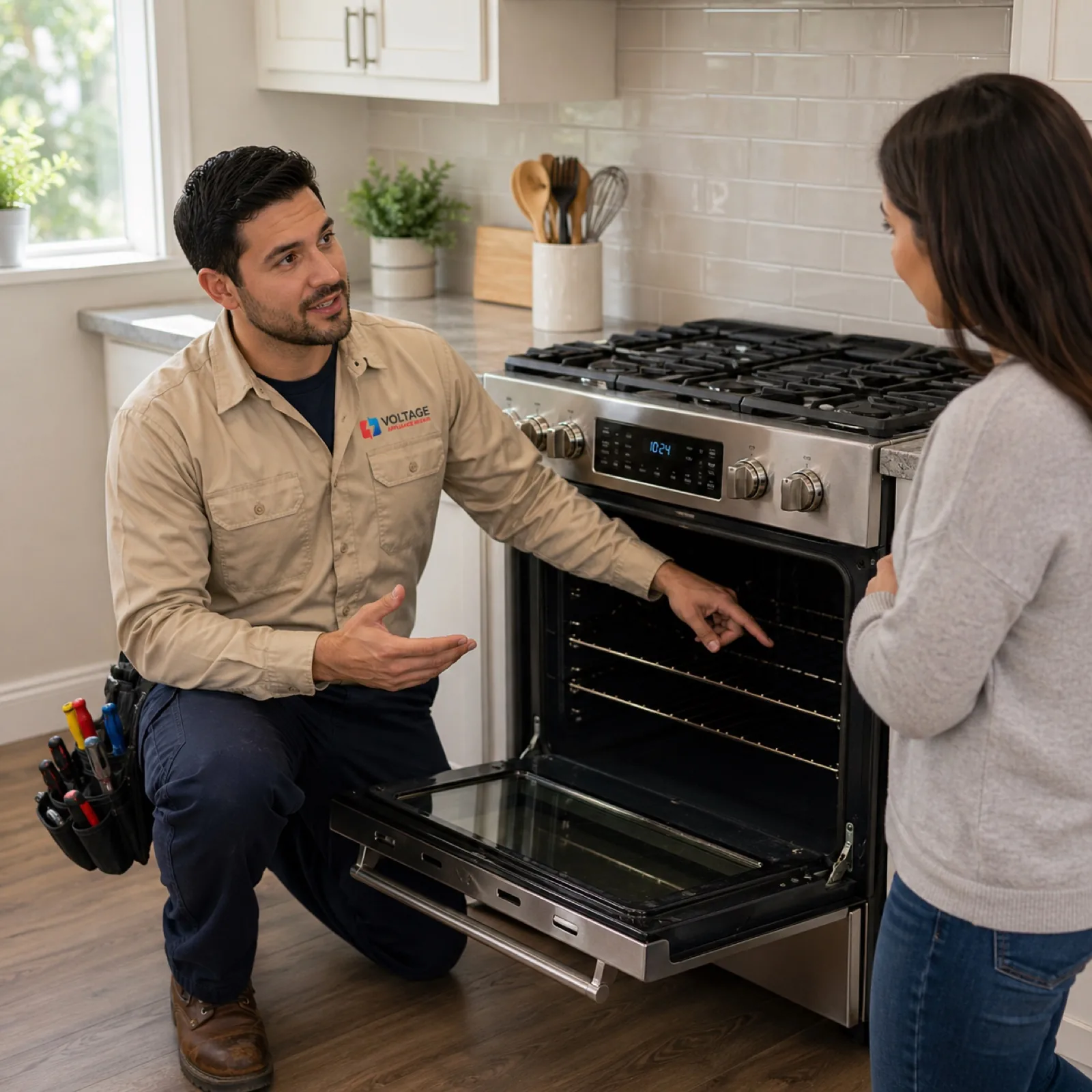
A used appliance can save you hundreds. It can also cost you more than a new one if you skip the basics. After thousands of service calls, here is what we look at before buying anything second-hand — no special gear beyond a multimeter and a flashlight.
Step Zero: Pull the Model Number First
Before anything physical, find the model number. It is usually on a sticker inside the door frame or along the side wall. Plug it into Google with the word "problems." Read the first three results.
Dealing with this right now? A free service call with your repair gets you an honest answer — fix it or skip it, quoted upfront. Call 786-869-3888 · same-day across Broward & Miami-Dade.
Some models have a known class-action history. Some have parts that are discontinued. A ten-year-old LG refrigerator compressor can cost more to fix than the fridge is worth — and that information is public.
Age matters too. Most appliances have a useful life of 10–15 years. If the unit is already at year 8 or 9, you are buying into the back half of its lifespan. Price accordingly or walk away.
1. Compressor Amp Draw (Refrigerators)
A fridge that runs is not a fridge that runs well. Pull it away from the wall, locate the compressor (the black cylinder at the bottom rear), and clamp a multimeter set to AC amps around the power cord.
A healthy residential compressor draws between 1 and 3 amps at steady state. If you see 5 amps or higher, the compressor is struggling — it is working twice as hard to maintain temperature. That means imminent failure or a refrigerant issue.
No clamp meter? Listen. A compressor that clicks on, runs for two minutes, clicks off, and immediately clicks on again is short-cycling. Short-cycling is a distress signal.
2. Drum Bearing Play (Washers)
Open the washer lid or door. Reach in and grab the drum with both hands. Push it up, pull it down, rock it side to side.
A drum with good bearings moves maybe a quarter inch in any direction. If it drops noticeably, clunks, or grinds during the push-pull test, the rear bearing is worn. Replacing that bearing on a front-load washer is a four-hour job on the bench — factor that into the price.
Also spin the drum by hand. Smooth is good. Rough or grinding is a warning. Squealing is a no.
3. Heating Element Resistance (Dryers)
Disconnect the dryer from power. Find the access panel — usually two screws on the back lower section. Locate the heating element (a coiled wire inside a metal housing) and disconnect the leads.
Set your multimeter to Ohms. Touch the probes to the element terminals. A working element reads between 8 and 50 ohms depending on the brand. An open circuit — no reading at all, or OL on a digital meter — means the element is burned out. Replacement is inexpensive, but it tells you the dryer has already been run hot, often from a clogged vent. That raises questions about what else was stressed.
While the panel is open, check the thermal fuse on the exhaust duct. Same test: continuity means it is fine, OL means it has blown. A blown fuse without an obvious cause is a yellow flag.
4. Interlock Switches (Dishwashers)
The door latch on a dishwasher does more than hold the door shut. It signals the control board that the door is closed before the machine will start. A worn or misaligned interlock is one of the most common reasons a "working" used dishwasher suddenly refuses to run after the sale.
Open and close the door firmly five times. Listen for a solid, consistent click. Then start a cycle and push lightly on the door — the cycle should continue without interruption. If pushing the door changes the behavior, the latch or the interlock switch behind it is marginal.
Also pull out the lower spray arm and spin it. It should rotate freely with no wobble. Check the filter at the bottom of the tub — pull it out, hold it to the light. Heavy mineral buildup means the unit lived somewhere with hard water and may have limescale inside the pump.
5. Model Age and Parts Availability (Everything Else)
For ovens, microwaves, and any appliance not covered above, the model-age check is your most reliable single filter. A discontinued model with no OEM parts available is a liability, not a bargain.
Check a parts supplier — search the model number on Repair Clinic or PartSelect. If fewer than a handful of parts come up, the supply chain has moved on. One failed board or sensor and the machine becomes a very heavy paperweight.
Bring Cash — But Earn the Discount
If any check turns up a red flag, you have two options: walk away or negotiate. A failed heating element is a $30–50 part. A bad compressor on a refrigerator is a $300–600 repair job. Know the number before you haggle.
A multimeter costs $20. A flashlight you already own. Five minutes of inspection is the cheapest diagnostic call you will ever make.
If you buy something and it surprises you later, we are one call away.