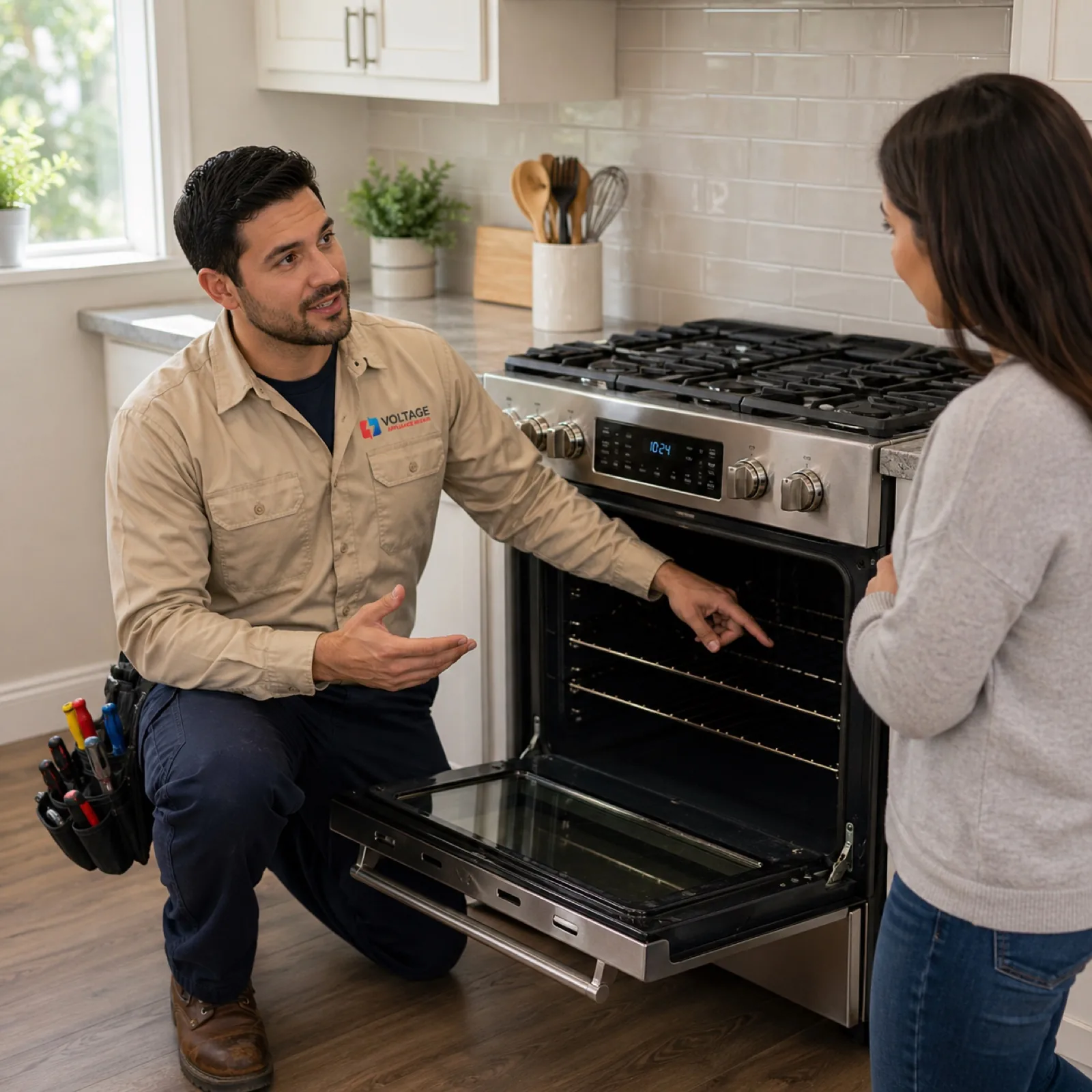
Your Viking range is dark. No heat. You assume the worst — a failed igniter, a dead control board, an expensive repair. Maybe a replacement.
Most of the time, the oven is fine.
That's not a guess. It's what our techs see on half of Viking "won't heat" calls. The fault lives upstream — in the circuit, the outlet, or the panel. The oven is just the last thing in a chain that already broke somewhere else.
Here's how we work through it before we ever touch the appliance.
Step One: The GFCI Check Nobody Thinks to Do
Viking electric ranges run on a dedicated 240V circuit. But the kitchen GFCI outlet — the one near the counter, sometimes in an adjacent bathroom — can interrupt that circuit under certain conditions. Most homeowners don't know they share a breaker group.
A tripped GFCI shows no error code. The oven display may stay dark entirely, or it may power up with no heat output. It looks like appliance failure. It's a reset button.
Our tech checks every GFCI on the kitchen circuit before opening a single panel.
Step Two: The Neutral Wire
240V circuits carry two hot legs and a neutral. The neutral balances the load and powers the control board. A loose neutral — especially at the junction box or breaker bar — drops the control board voltage without killing the hots.
What you see: the oven clock works, the display lights up, surface burners ignite. But the oven won't heat. The board is alive. The bake element isn't getting a clean signal.
This is a wall problem, not an oven problem.
The tech pulls the breaker cover and checks torque on the neutral terminal. Loose connections in Florida kitchens are more common than people expect — heat cycling and humidity work the screws loose over years. Retorquing a terminal costs nothing. Replacing a control board costs several hundred dollars.
We check the wiring first. Always.
Step Three: The Aging Contactor
Older Viking installations — especially 2007 to 2014 — used a wall-mounted contactor to switch the oven circuit. It's a relay that lives in a junction box between the panel and the range. They last about 15 years.
When a contactor starts failing, it chatter-switches. The oven heats inconsistently: works one morning, dead the next, back by dinner. Homeowners assume the bake element is going. They order parts. They're wrong.
A failed contactor is a $40 part and a 20-minute swap. A bake element replacement on a Viking is $200+ in parts alone. We check the contactor before the element. Every time.
Step Four: Voltage at the Terminal Block
If GFCI, neutral, and contactor all check out, the tech pulls the range slightly forward and tests voltage at the terminal block — the point where house wiring meets the appliance. We're looking for 240V across both hots, 120V from each hot to neutral.
Anything less, and the problem is still upstream. A service panel issue, a damaged leg on the utility feed, a deteriorating range cord. We identify it here before the diagnostic moves inside the unit.
If all four readings are clean? Now we look at the oven.
Why This Sequence Matters
Viking appliances are built well. The components are engineered to last. When a Viking oven stops heating, the component has usually earned its failure — but more often, something external failed first.
A tech who skips the panel check and goes straight to the element is guessing. They may replace a $200 part that was never the problem. The fault comes back in two weeks. Now you're frustrated, out money, and no closer to a working oven.
Our sequence is deliberate. Panel first. Wiring second. Appliance third. It takes 15 minutes longer at the start and saves hours of backtracking.
What to Tell Your Tech
If you're calling anyone about a Viking oven that won't heat, ask them one question before they open the unit: "Did you check the circuit first?"
The answer tells you a lot about how that technician works.
We check the panel. We check the wiring. We find the real fault — wherever it lives. Then we fix it once.
That's the job.