
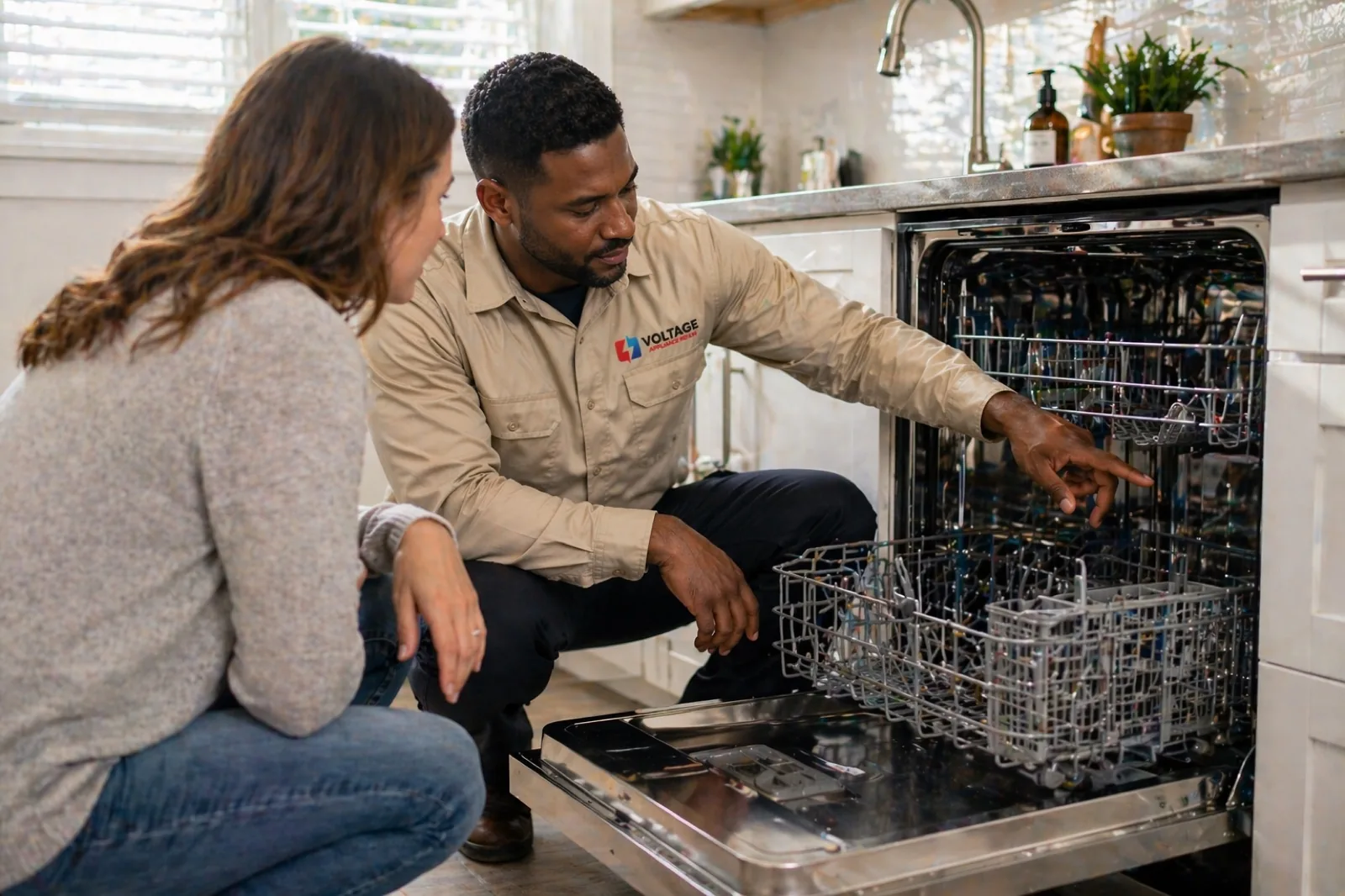
You cleaned the filter. You checked the drain hose. You verified the garbage disposal connection. Water is still sitting at the bottom of the tub.
That narrows it down. The drain pump is almost certainly the problem.
Dealing with this right now? A free service call with your repair gets you an honest answer — fix it or skip it, quoted upfront. Call 786-869-3888 · same-day across Broward & Miami-Dade.
Drain pump issues account for roughly 20% of dishwasher no-drain calls. That's the minority — but it's the part most homeowners know the least about. Understanding what the pump does, how it fails, and what good repair looks like saves you from surprises when a technician shows up.
What the Drain Pump Actually Does
The drain pump is an electric motor with a small impeller — a spinning blade — mounted at the bottom of the dishwasher tub. At the end of every wash cycle, it activates and forces water out through the drain hose to your sink or disposal connection.
It runs for about 90 seconds per cycle. Across a year of daily use, that's roughly 550 cycles. The motor is small. The load is real. Wear accumulates.
The pump doesn't work with gravity. It generates the pressure that moves water out. When it fails, the water has nowhere to go.
Two Ways a Drain Pump Fails
1. Mechanical jam. The impeller gets blocked by something that made it past the filter — a broken glass chip, a twist tie, a food-service toothpick, a small piece of plastic wrap. The motor receives the signal to run, strains against the obstruction, and trips a thermal fuse or simply stops turning.
On a jam, the motor itself may still be fine. Clear the obstruction, reset the machine, and the pump often resumes normal operation. This is the better scenario.
2. Motor burnout. The pump motor fails electrically — a winding shorts, a capacitor goes, or the motor simply reaches end of life. No obstruction. No debris. The pump runs to failure or stops responding to the control signal entirely.
A burnt motor cannot be repaired. The pump assembly gets replaced.
You can usually distinguish the two with a multimeter reading across the pump terminals — a tech will do this before pulling anything apart.
What You'll Hear (or Won't)
A dishwasher with a jammed impeller often makes a distinct noise at the end of the cycle: a low hum or grinding that stops after a few seconds. The machine tries to drain, something fights back, and the motor cuts out.
A machine with a dead pump motor is quieter at that stage. The drain phase simply doesn't happen. No hum. No movement. Just standing water.
Neither symptom is 100% diagnostic on its own, but they point the technician in the right direction before the panel comes off.
Why the Right Part Has to Be on the Truck
Dishwasher drain pumps are not universal. The correct replacement depends on your exact make and model — and in some cases, the production year matters too. Bosch uses a different pump assembly than LG. Miele's pump specs are tighter than most mainstream brands. KitchenAid pumps vary across their own lineup.
A technician who shows up without the right pump leaves, orders the part, and returns. That's two visits, two service windows, and a dishwasher that stays unusable in between.
The fix for that is confirming your model number before anyone arrives. The make and model are usually on a label inside the door — left rail, right rail, or door edge. Take a photo. Share it. A prepared technician brings the right pump and closes the job in one visit.
What Repair Actually Looks Like
Drain pump replacement on a typical dishwasher takes 45 to 75 minutes on-site. The machine gets pulled from the cabinet, tilted onto its side, and the pump assembly is accessed from the base. It's bolted to the tub and connected with a wiring harness and a hose clamp.
No soldering. No specialty tools. It's a mechanical swap — disconnect, remove, reinstall, reconnect.
The technician runs a full drain cycle before pushing the machine back. Water flows. The repair is confirmed before they leave.
A Note on Older Machines
If the dishwasher is more than 10 years old, it's worth pausing before approving a pump replacement. On a machine that age, the pump failure may be the first sign of broader wear — door seal, wash pump, spray arms. Ask the technician to assess the full machine before committing to the part.
On a newer machine — five years or under — replace the pump with confidence. These machines have years left in them. One pump swap is a reasonable investment.
The Takeaway
Drain pump failure is the one dishwasher no-drain cause you can't clear yourself. But it's also completely fixable in a single visit when handled correctly. Clean filter, clear hose, working disposal connection — and if water still won't move, the pump is what's left. Know your model number. Share it before the tech arrives. The rest is straightforward.