
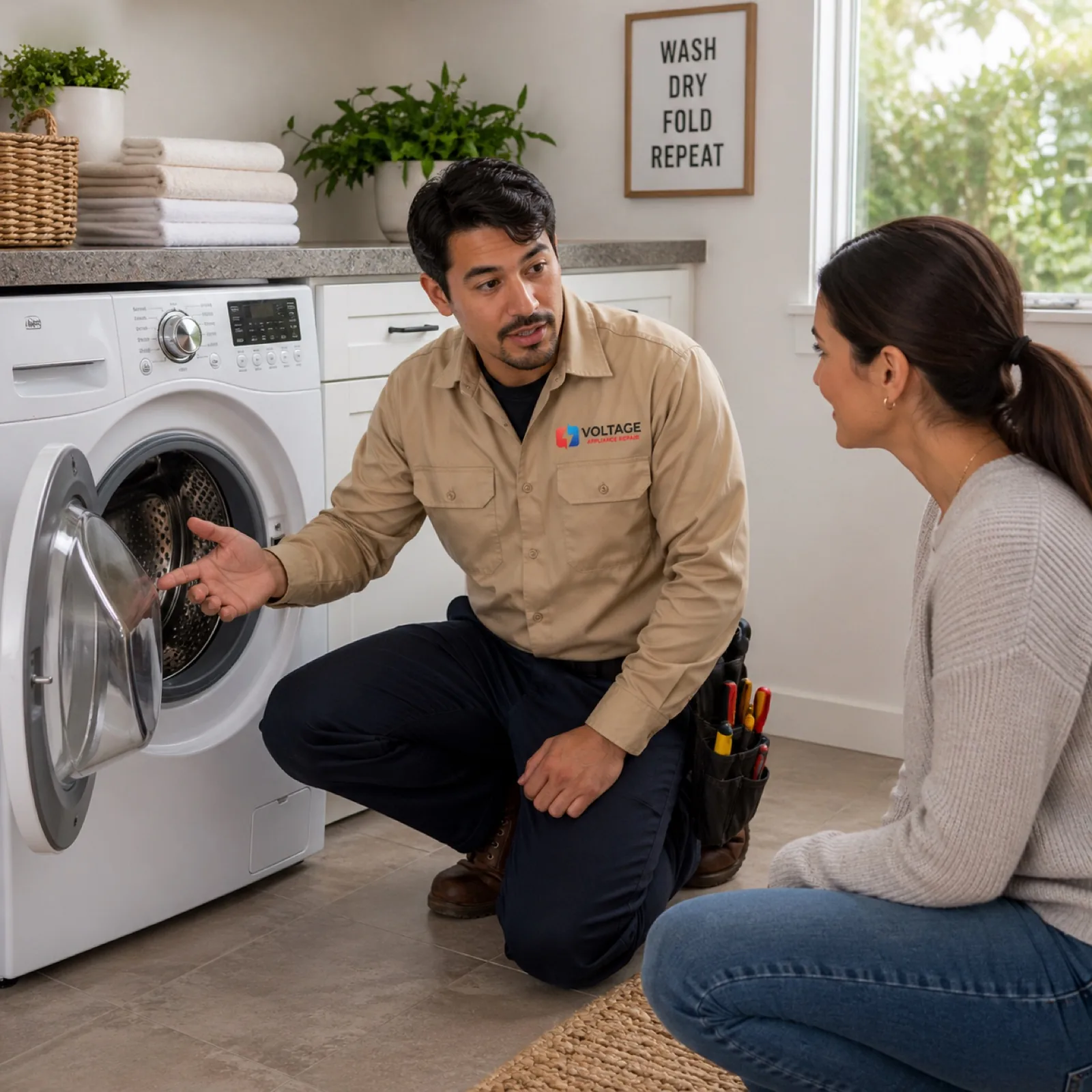
A dryer that runs but blows cold air is one of the most common repair calls we get. The drum spins. The timer counts down. But clothes come out damp — every single time. Three components cause this almost every time. Two of them you can check yourself. One requires a tech with a multimeter.
Work through them in this order. It saves time and prevents misdiagnosis.
Dealing with this right now? A free service call with your repair gets you an honest answer — fix it or skip it, quoted upfront. Call 786-869-3888 · same-day across Broward & Miami-Dade.
1. Check the Vent First (Owner Can Do This)
Before you assume anything is broken, check the vent.
A clogged exhaust vent is the most overlooked cause of no-heat drying. When airflow is blocked, the dryer's safety thermostat trips and shuts off the heat to prevent a fire. The drum keeps turning. The heat does not.
What to check:
- Pull the dryer away from the wall and inspect the duct behind it. Look for kinks, crushed sections, or disconnected joints.
- Go outside and find the vent termination cap. Reach in (with the dryer off) and feel for lint buildup. If it's packed, that's your problem.
- Run the dryer for two minutes, then hold your hand near the exterior vent opening. You should feel a strong, steady exhaust. Weak or no airflow = blockage.
A standard dryer vent should be cleaned at least once a year. In South Florida, where humidity already stresses dryers, twice a year is better. A $20 dryer vent brush kit handles most clogs in under 30 minutes.
If the vent is clear, move to step two.
2. Check the Circuit Breaker (Owner Can Do This)
Electric dryers run on a 240-volt circuit — two breakers in one. Here's the catch: if one leg of that circuit trips, the dryer gets half its power. The motor runs. The heating element does not.
What to check:
- Open your breaker panel and look for the dryer breaker. It should be a double-pole breaker (two switches joined together).
- If one side has tripped, it may look only slightly out of position — not fully flipped to OFF. Reset it firmly: push it all the way to OFF, then back to ON.
- Try the dryer again.
This is a five-minute fix that catches a surprising number of no-heat calls. If the breaker trips again immediately, stop. There's an underlying wiring or component issue. That's a tech call.
Gas dryers don't use a 240V circuit for heat, so this step doesn't apply to gas units.
3. The Thermal Fuse and Heating Element (Requires a Tech)
If the vent is clear and the breaker is fine, the fault is almost certainly inside the dryer itself.
Thermal fuse: This is a one-time safety device that blows when the dryer overheats. Once it blows, it doesn't reset. The dryer runs normally — it just produces no heat at all. A blown thermal fuse is often caused by a clogged vent (see step one), so if you skipped that, go back.
A tech checks the thermal fuse with a multimeter continuity test. The test takes about ten minutes. No continuity = blown fuse. Replacement is straightforward, but finding the fuse — and safely accessing it — varies by brand. On some Samsung and LG models it's behind the back panel. On some Whirlpool units it's tucked near the exhaust duct inside the cabinet.
Heating element: If the thermal fuse is intact, the heating element itself may have failed. Elements burn out over time, especially in dryers that have run hot due to vent restrictions. Again, a continuity test confirms it. An open circuit across the element terminals means it's done.
Both parts are relatively inexpensive. Labor is the larger cost. A good tech diagnoses both in the same visit, replaces what's needed, and tests before leaving.
What This Means for You
Here's the triage in plain terms:
| Check | Who Does It | Time | |---|---|---| | Vent inspection and cleaning | Owner | 20–30 min | | Breaker reset | Owner | 5 min | | Thermal fuse continuity test | Tech | 10 min | | Heating element continuity test | Tech | 10–15 min |
Start with the vent. Always. A large percentage of no-heat calls trace back to restricted airflow — and it's the one thing you can fix for free today.
If the vent is clear, check the breaker. If the breaker is fine, the repair is inside the machine. At that point, you need a real diagnosis — not a guess.
We carry thermal fuses and heating elements for all major brands on every truck. Most no-heat dryer calls are resolved in a single visit. Call (786) 869-3888 if you're ready to stop guessing.