
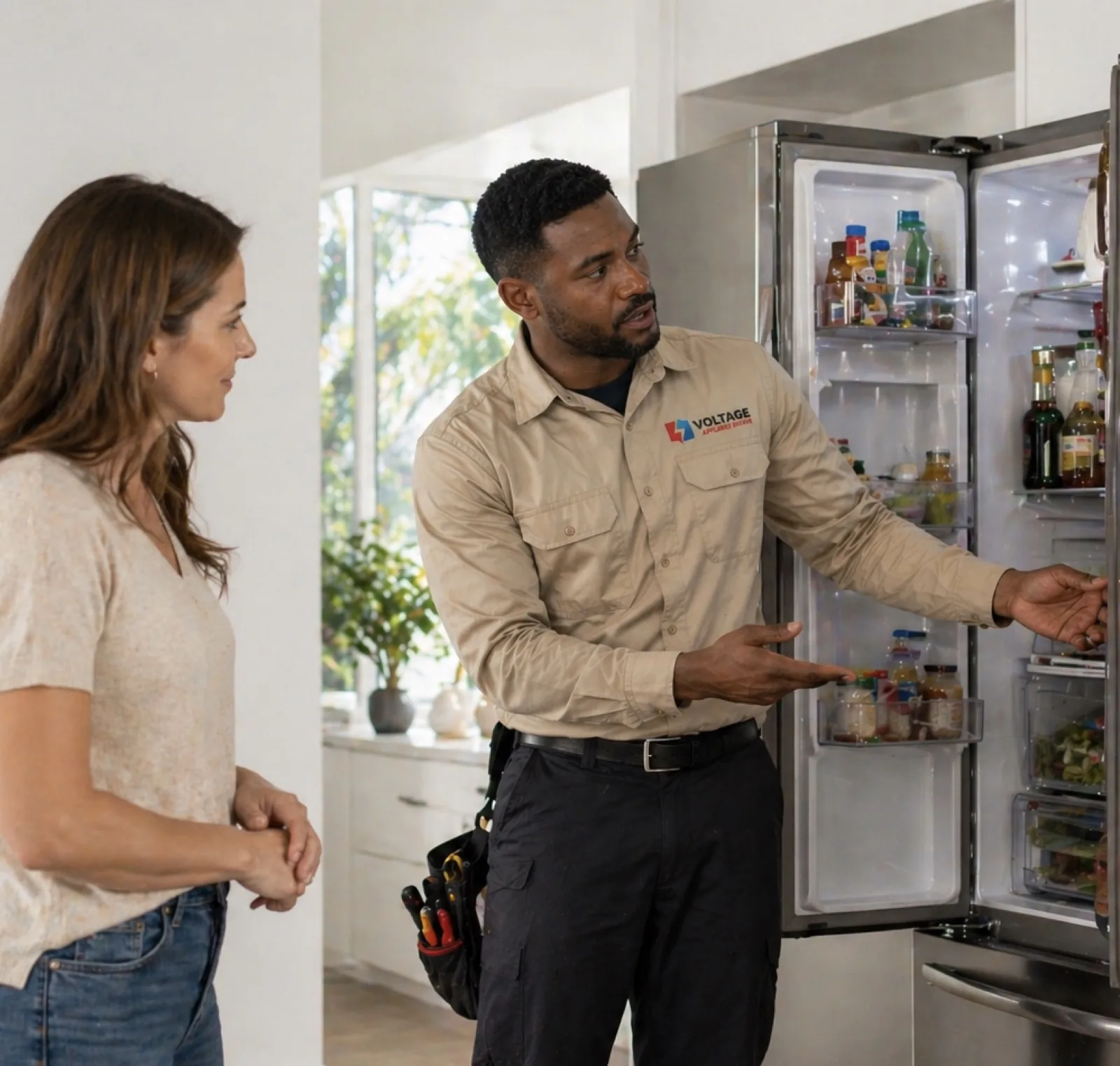
One half of your fridge is cold. The other isn't. You open the freezer — ice cream solid, frozen peas still frozen. You open the fresh food side — lettuce wilting, milk warmer than it should be.
Your first thought: compressor failure. Expensive. Maybe not worth fixing.
Dealing with this right now? A free service call with your repair gets you an honest answer — fix it or skip it, quoted upfront. Call 786-869-3888 · same-day across Broward & Miami-Dade.
That thought is almost always wrong.
Here's why — and what's actually going on inside your fridge right now.
The Compressor Is Probably Fine
Here's the key detail most people miss: your refrigerator has one compressor that serves both compartments. The freezer and the fresh food section share the same refrigeration system.
If the compressor were dead, both sides would be warm. Both. No exceptions.
So if the freezer is holding temperature — even imperfectly — the compressor is running. The expensive part is doing its job. What you have is a delivery problem, not a generation problem. Cold air is being made. It's just not getting where it needs to go.
That's a fundamentally different repair.
Where Cold Air Actually Comes From
Most refrigerators — including French door, top-freezer, and side-by-side models — work the same way. Cold air is generated in the freezer section, then a small fan (the evaporator fan) pushes that air through a duct and into the fresh food compartment via a damper.
The fresh food side doesn't make its own cold. It borrows it.
When that borrowing stops, you get exactly what you're describing: freezer fine, fresh food warm.
Three components are responsible for almost every case of this failure pattern.
The Three Usual Suspects
1. The Evaporator Fan
This is the fan that moves cold air from the freezer coils into the rest of the fridge. When it fails — motor burns out, blade freezes in place, gets obstructed — air circulation stops.
You can often hear this one. Open the freezer door. If the fan isn't running when the compressor is on, that's your culprit. Some models have a door switch that kills the fan when the door is open — hold that switch manually and listen.
Fan replacement is one of the simpler fridge repairs. Parts are usually in stock.
2. The Damper (Air Diffuser)
The damper is a small flap between the freezer and fresh food sections. It opens and closes to regulate how much cold air flows through. On most modern fridges, it's electronically controlled.
When the damper sticks shut — or fails closed — the fresh food side gets no air at all. The freezer stays unaffected. The symptom is exactly what you're seeing.
This is a direct, usually inexpensive repair. The damper assembly itself is the part, plus the labor to access it.
3. Frost Blocking the Vent
This one is the sneakiest. Inside your freezer walls, there's an evaporator coil surrounded by a defrost system. If the defrost system fails — heater, thermostat, or timer — frost accumulates on those coils over days or weeks.
Eventually, the frost builds up enough to block the vent that delivers air to the fresh food section. The coils are still cold. The freezer still works. But air can't move past the ice barrier.
A tech can confirm this quickly. The fix is a full defrost cycle — manual or forced — followed by diagnosing why the defrost system stopped working in the first place.
Why This Matters Before You Call Anyone
Understanding the failure pattern protects you.
When a tech arrives and tells you it's the compressor on a fridge with a working freezer — that's a red flag. Ask them to explain why the freezer is holding temperature if the compressor has failed. A confident, specific answer is a good sign. Vague deflection is not.
The repairs for damper, fan, and defrost system range from straightforward to moderate. None of them require replacing the refrigeration system. You're looking at a part swap, not a unit replacement.
One Exception Worth Knowing
French door refrigerators — particularly certain LG and Samsung models — can develop a different version of this pattern related to ice maker issues or sealed system problems. The freezer-fine symptom looks the same, but the root cause can vary.
If your fridge is fewer than five years old and it's a newer French door unit, mention the model number when you call. It helps a tech come prepared.
The Short Version
Freezer cold. Fresh food warm. That split tells you the compressor is running.
The problem is almost always a stuck damper, a failed evaporator fan, or frost blocking the air duct. All three are diagnosable in a single visit. All three are fixable without replacing your refrigerator.
Don't let the symptom convince you it's worse than it is. It rarely is.
Call us and we'll sort it out — same day, most of the time.