
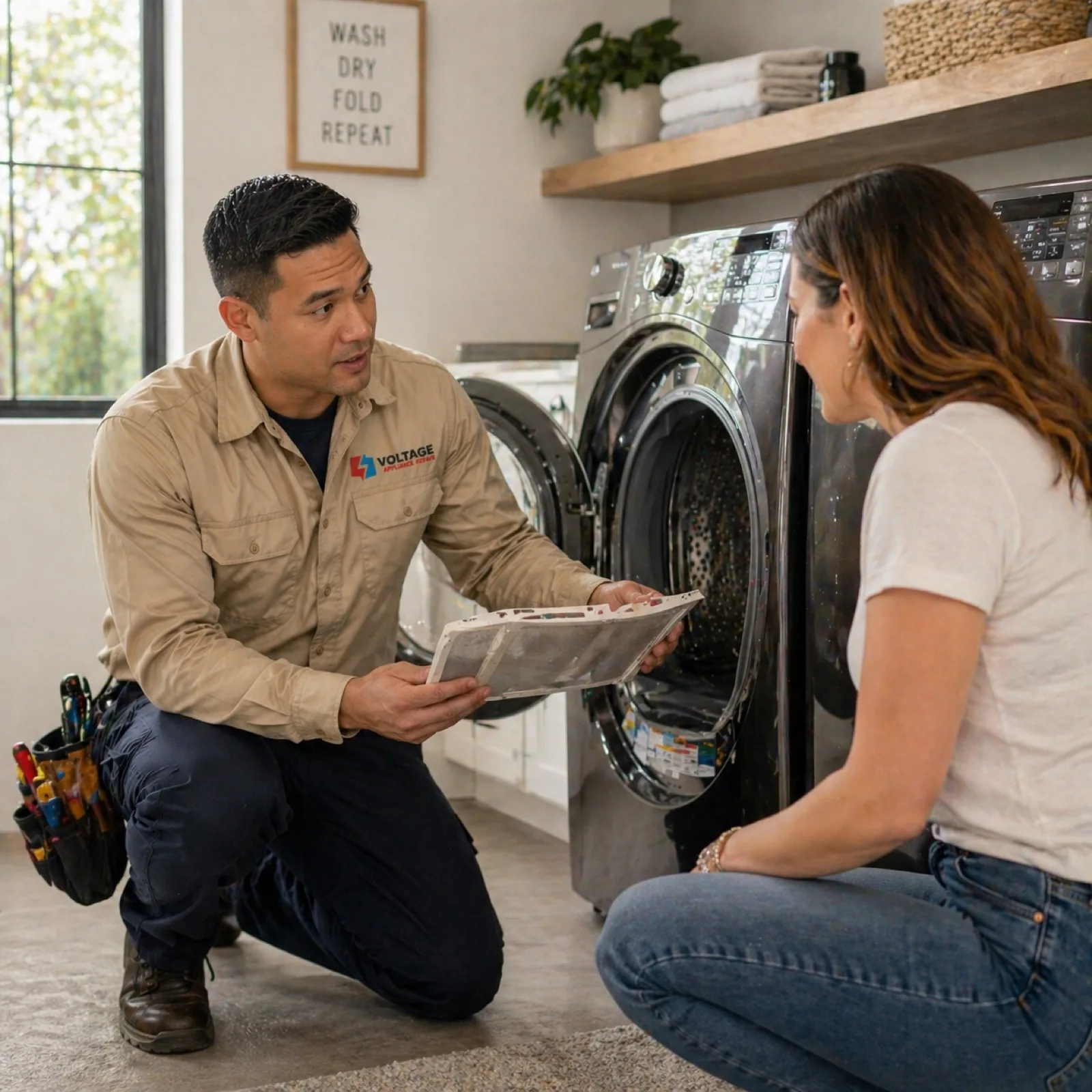
Your front-loader came with a seal. That seal has folds. And inside those folds, South Florida has been quietly building a mildew colony since the day you installed the machine.
It's not a defect. It's physics — combined with the fact that Miami-Dade and Broward sit at 75–80% average relative humidity year-round. The same washer that a homeowner in Chicago wipes out once a month can turn sour here in ten days. Same machine. Different climate.
Dealing with this right now? A free service call with your repair gets you an honest answer — fix it or skip it, quoted upfront. Call 786-869-3888 · same-day across Broward & Miami-Dade.
Here's where the odor lives, and how to clear it out.
The Three Problem Spots
1. The Door Gasket Folds
The rubber bellows around the front-loader door is the number-one odor source. It's designed with deep folds — necessary for the seal to flex — and those folds trap lint, soap residue, and standing water after every cycle.
Pull the gasket back with your fingers and look inside the fold. If you see dark spots, that's mold. If you see pink or orange film, that's a biofilm — a different microorganism, same result.
Wipe the entire fold with a damp cloth after every wash. Not just the visible surface — the full interior of the crease. In Florida, this isn't optional. It's part of every cycle.
2. The Dispenser Drawer
Fabric softener and detergent don't fully flush out of the drawer with every cycle. The residue sits in the compartment tray and the housing behind it — that dark channel where water flows in from the top. That channel stays damp and is almost never cleaned.
Pull the drawer out completely. Most front-loaders have a release tab — press it and the drawer slides free. Rinse the drawer itself under hot water. Then use a small brush (an old toothbrush works) to scrub the housing cavity, especially the back wall and ceiling of the compartment. Let both pieces dry before sliding the drawer back in.
Monthly. Every time.
3. The Drain Pump Filter
This one surprises most homeowners. Front-loaders have a small filter — usually behind a kick panel at the bottom front of the machine — that catches lint, coins, and debris before it reaches the pump. It also traps water.
If you've never cleaned yours, open it carefully: place a shallow pan under the cap, unscrew slowly, and expect a cup or two of water to drain out. Rinse the filter under running water, check the cavity for debris, and reinstall.
A clogged or dirty filter doesn't just smell. It can cause the machine to drain slowly or not at all. Which brings up an important distinction.
Cleaning Issue vs. Drain Issue — How to Tell
Mildew smell from the gasket and drawer responds to cleaning. You clean, the smell goes away. It comes back in a few weeks if you don't stay consistent — but it responds.
A drain problem behaves differently. The smell is stronger and more persistent. It often has a sewage or sulfur note — not just musty, but actively foul. The machine may take longer to drain than it used to. You might see water pooling in the drum after the cycle ends. The smell comes back quickly even after a cleaning cycle.
If you're running monthly maintenance and the odor keeps returning within days, the issue is likely downstream of the drum: the filter, the pump, or the drain hose. The hose can develop a biofilm buildup over years, especially at the bottom of the loop where it connects to the standpipe. That's not a cleaning job — it's a service call.
The Monthly Florida Routine
Keep this on a calendar. Five minutes at the end of the month:
- Gasket wipe-down — pull back every fold, wipe out moisture and residue
- Dispenser drawer pull — remove, rinse, scrub the housing cavity, let it dry
- Drain filter check — unscrew, drain, rinse, inspect for debris
- Drum cleaning cycle — use the machine's built-in clean cycle (or a washer tablet on the hottest setting) with the door left open afterward to vent
Leave the door cracked open between uses. Every load, every time. The drum needs to breathe. In South Florida, a closed drum is a closed terrarium.
One More Florida-Specific Factor
If your washer is in a garage or an enclosed utility space without AC, ambient temperatures can hit 90°F or above. That accelerates every biological process — mold grows faster, biofilm thickens faster, odors concentrate faster.
If your laundry area isn't climate-controlled, your monthly routine becomes a two-week routine. The machine didn't change. The environment did.
Stay consistent. The smell doesn't come back when you don't give it a place to live.