
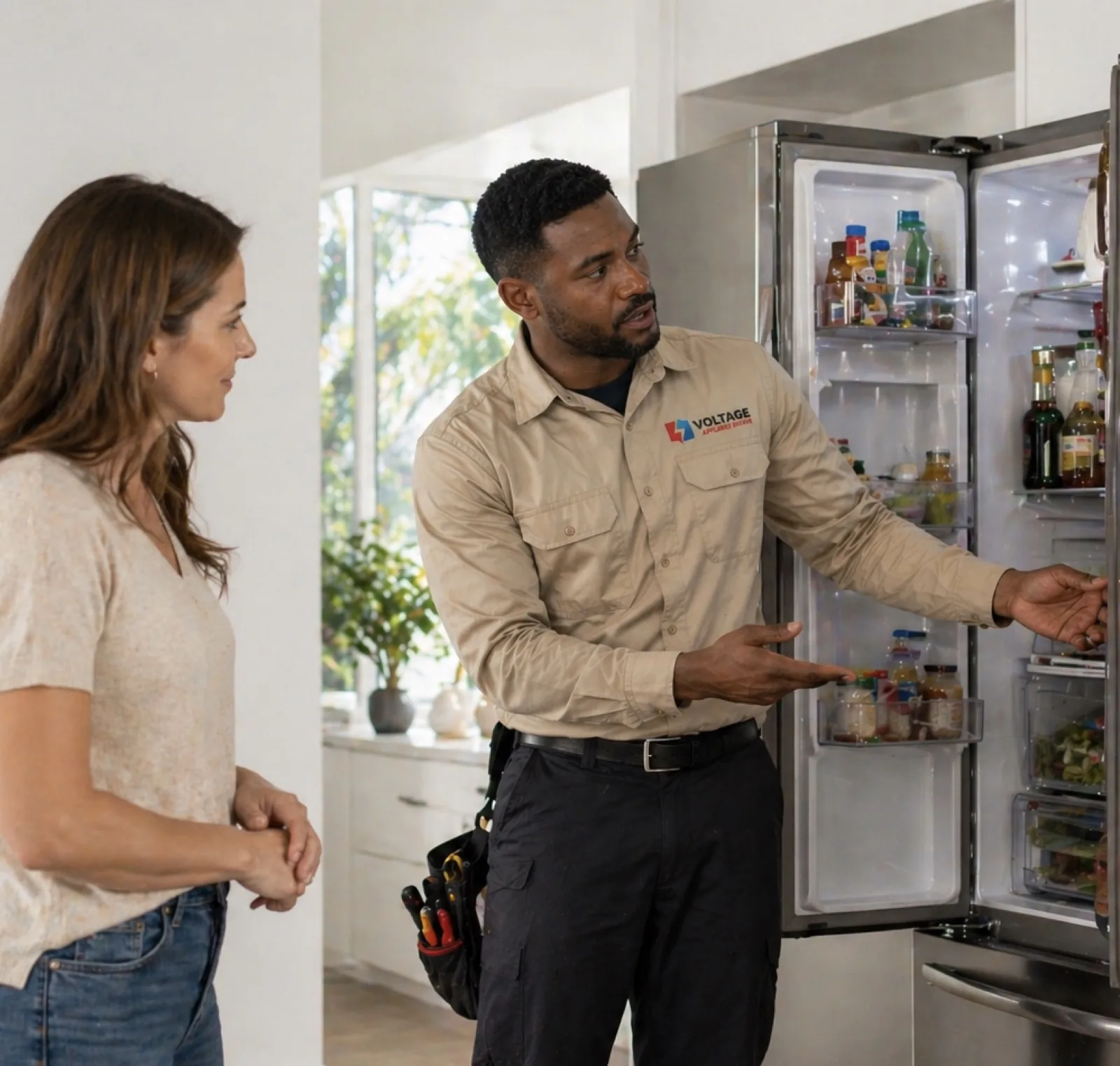
Your freezer is perfectly cold. Ice cream solid. Frozen peas frozen. But the refrigerator side? Warm milk. Wilting lettuce. A vague, worried feeling.
This is one of the most common refrigerator calls we get. The good news: a working freezer tells you the compressor is running. Cold is being made. Something is just preventing it from reaching the fridge compartment. That narrows the diagnosis considerably.
Dealing with this right now? A free service call with your repair gets you an honest answer — fix it or skip it, quoted upfront. Call 786-869-3888 · same-day across Broward & Miami-Dade.
Work through these five checks in order. You may find the answer before you ever pick up the phone.
1. Check the Air Damper (Start Here)
Cold air travels from the freezer into the fridge through a small duct controlled by a damper — sometimes called an air diffuser or baffle. When it's stuck closed, the freezer stays cold and the fridge starves.
Locate the damper on the back wall of the fridge compartment, usually near the top. On most models, you can feel it with your hand or gently press it open. If it moves freely and closes on its own, it's probably fine. If it's frozen in place or jammed shut, you've likely found your problem.
A stuck damper is often caused by ice buildup around the duct — which points back to a defrost issue (see check four).
2. Listen for the Evaporator Fan
The evaporator fan sits inside the freezer compartment, behind a panel. Its job is to push cold air through the duct system into both sections. If it stops running, the fridge side loses airflow even though the freezer stays cold from radiant proximity.
Open the freezer door and listen. You should hear a fan running. If you don't — or if it's grinding, cycling on and off, or stops when you press the door switch — the fan motor is a strong suspect.
Some refrigerators pause the fan when the door is open. Press and hold the door switch while listening. Fan should keep running.
3. Check the Condenser Fan (Bottom-Mount Compressors)
On most modern top-freezer and side-by-side refrigerators, the compressor and condenser sit at the bottom rear. A small fan pulls air across the condenser coils to dissipate heat. When this fan fails or the coils are clogged with dust, the compressor overheats and starts short-cycling. Cooling becomes inconsistent — and the fridge feels it first.
Pull the unit away from the wall. Remove the lower rear access panel. Look for the condenser fan next to the compressor. It should be spinning when the compressor runs. While you're there: check the coils. If they're packed with dust and pet hair, vacuum them out. This alone can restore normal operation.
4. Defrost Cycle — Is Ice Blocking Everything?
All frost-free refrigerators run a defrost heater periodically to melt ice off the evaporator coils. If the heater, defrost thermostat, or defrost timer fails, ice builds up on the coils until airflow is completely blocked.
The giveaway: the fridge section is warm, but if you run your hands along the freezer back panel, it feels unusually icy or you can hear the fan straining. Sometimes you'll notice the problem cycling — cold for a few hours, then warm again.
Diagnosing a defrost failure correctly requires reading component resistance with a multimeter. The heater, thermostat, and control board each need to be tested individually. This is the step where most DIY troubleshooting hits its limit.
5. Temperature Sensor (Thermistor)
The fridge compartment uses a thermistor to report its temperature to the control board. If the sensor reads colder than actual, the board never calls for more cooling. The freezer keeps its own separate sensor and stays cold. The fridge slowly warms.
A bad thermistor usually doesn't trip an error code on older models. On newer ones, it may — check the display for any fault codes and cross-reference your model's service manual. Testing requires a multimeter and a known resistance value for your specific sensor.
When to Stop and Call
You've checked the damper. You've listened for the fan. You've cleared the condenser coils. If the fridge is still warm after those three checks, the problem almost certainly lives in the defrost system or a failed component that needs electrical testing.
That's not a judgment on your ability. It's just the nature of the repair — guessing at components gets expensive fast. A proper diagnosis with the right tools takes about 30 minutes and tells you exactly what needs replacing before any parts are ordered.
If your freezer is cold and your fridge isn't, the fix is almost always straightforward once the right component is identified. Don't let warm food sit — this one doesn't resolve on its own.
Call us at (786) 869-3888. Same-day visits are open most days when you call before 2 PM.