
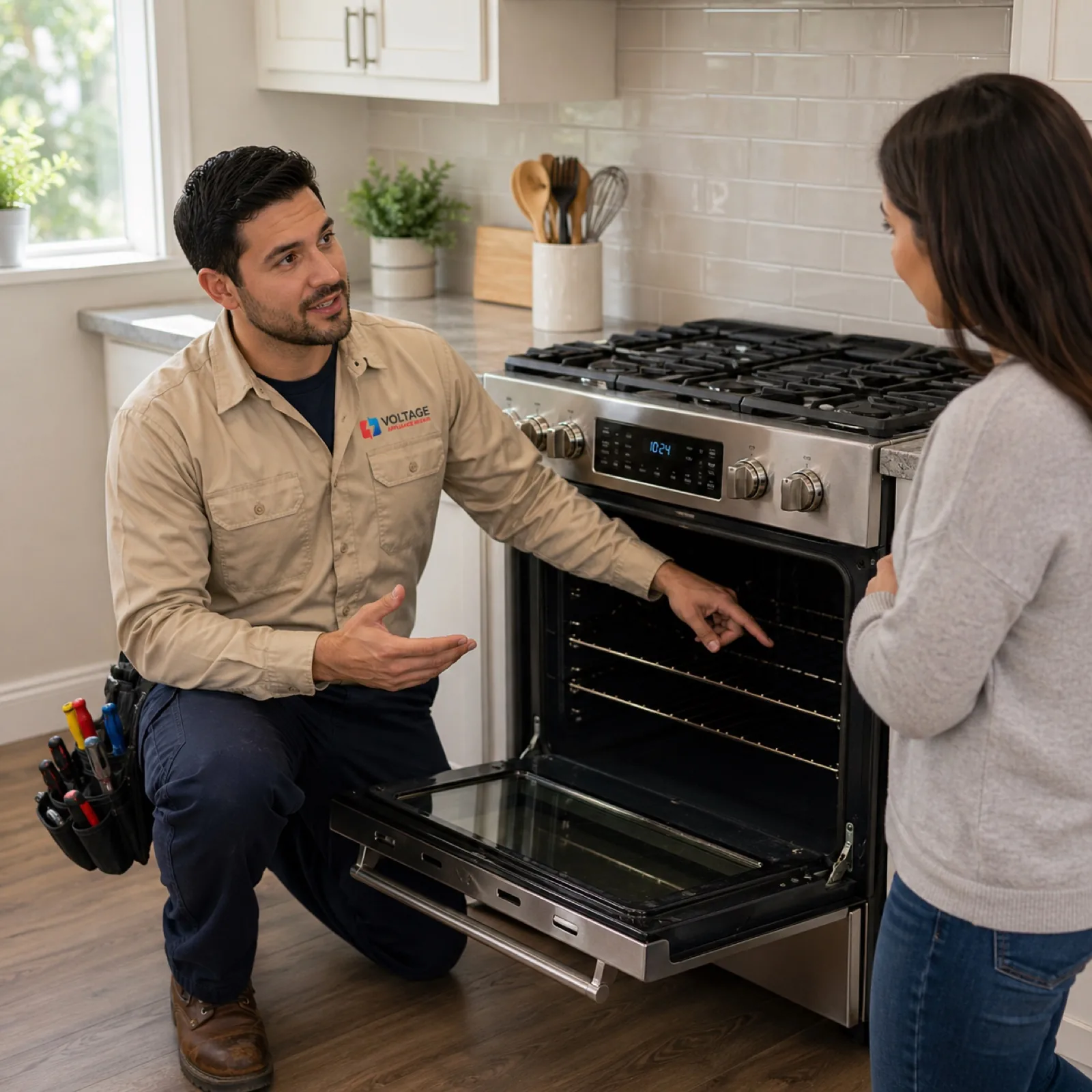
Your cookies are burnt on the bottom and raw in the middle. Your cake domes on one side. Your roast is done on the right, still pink on the left. The oven runs. It gets hot. But it doesn't bake evenly.
This is one of the most common oven complaints we see. And it almost always comes from one of three places: the bake element, the hidden bake element, or the convection fan. Not the temperature sensor — despite what most YouTube videos tell you.
Dealing with this right now? A free service call with your repair gets you an honest answer — fix it or skip it, quoted upfront. Call 786-869-3888 · same-day across Broward & Miami-Dade.
Here's how to test each one. Methodically. Before you spend money on a part that won't fix it.
Start With the Bake Element (Visible Glow Check)
In most traditional ovens, the bake element sits exposed across the bottom of the cavity — a thick metal rod in a U or C shape.
How to test it: set the oven to bake at 350°F. Watch the element as it heats. Within three to five minutes, it should glow a uniform, consistent orange-red from one end to the other. No dark spots. No sections that stay black. No flickering.
If part of the element stays dark while the rest glows, it's heating unevenly — or failing entirely. That section is no longer producing heat. The oven compensates by running longer, but the heat distribution is already off. Uneven baking is the result.
A damaged bake element is usually visible too. Look for blistering, cracks, or a hole burned through the metal. Any of those means replacement. This is a straightforward fix — the part is accessible, and on most mainstream brands it's a two-screw job.
Hidden Bake Element (Newer Ovens)
Newer ranges — especially Samsung, LG, Bosch, and most high-end brands — hide the bake element under the oven floor. Clean look. No drip burns. But you can't see it glow.
Testing is different here. You're reading behavior, not light. Set the oven to bake and place a sheet of plain white copy paper flat on the oven rack in the center position. Leave it for four minutes at 350°F. Pull it out and look at the browning pattern. It should be consistent, edge to edge. Hot spots will show as darker patches. A cold zone means the element beneath isn't firing uniformly — or at all in that section.
Some hidden elements fail in one segment only. The oven reads the cavity temperature as normal (the sensor's average is fine) but the floor heat is lopsided. That's why the sensor gets the wrong blame.
Convection Fan (Even-Distribution Check)
If your oven has a convection fan — a fan and a second heating element, usually at the back wall — it's supposed to circulate heat evenly throughout the cavity. When it works, it eliminates hot spots. When it doesn't, it creates them.
Two failure modes: the fan itself stops spinning, or the convection element behind it burns out partially.
How to test it: switch to convection bake. Listen. You should hear steady airflow — not loud, but consistent. Watch the back wall through the oven window if you can. The fan should spin at a constant rate with no wobble or grinding.
Then run the paper test again on convection mode. Comparing the browning pattern from regular bake vs. convection bake tells you quickly whether the fan is circulating heat or just running for show.
A convection fan that spins but doesn't move air is usually caused by a worn bearing or loose blade — the motor runs but the draw is weak. That needs a tech. It's not a DIY fix because the back panel and element wiring are involved.
Why the Temp Sensor Is Usually Not the Problem
Search "oven bakes unevenly" and you'll see a hundred videos pointing at the temperature sensor. Replace it, they say. It's only $15.
Here's the thing: the temp sensor tells the oven when the cavity has reached the target temperature. It doesn't control where the heat comes from or how it moves. A failing sensor causes your oven to run too hot or too cool overall — not to burn one side and undercook the other.
If your oven is consistently off by 25 or 50 degrees — everything comes out overdone, or nothing browns properly — that's a sensor issue. Uneven results from side to side, top to bottom, or corner to corner? That's element or fan. Different problem. Different part.
Replacing the sensor when the element is failing wastes money and time. Worse, it gives you false confidence. The real cause is still in there.
What to Do Next
If the glow test shows a dark section — element replacement. If the paper test shows a cold zone in a hidden-element oven — element or wiring inspection. If convection sounds wrong or the airflow test fails — fan and convection element inspection.
None of these are guesses. They're direct tests that point at specific parts. That's how a real diagnosis works.
If you're not comfortable pulling panels or working near high-voltage wiring, stop after the tests. You'll have a clear picture of what's wrong — that information alone makes the repair call faster, cheaper, and more accurate. Call us and tell us what you found. We'll take it from there.