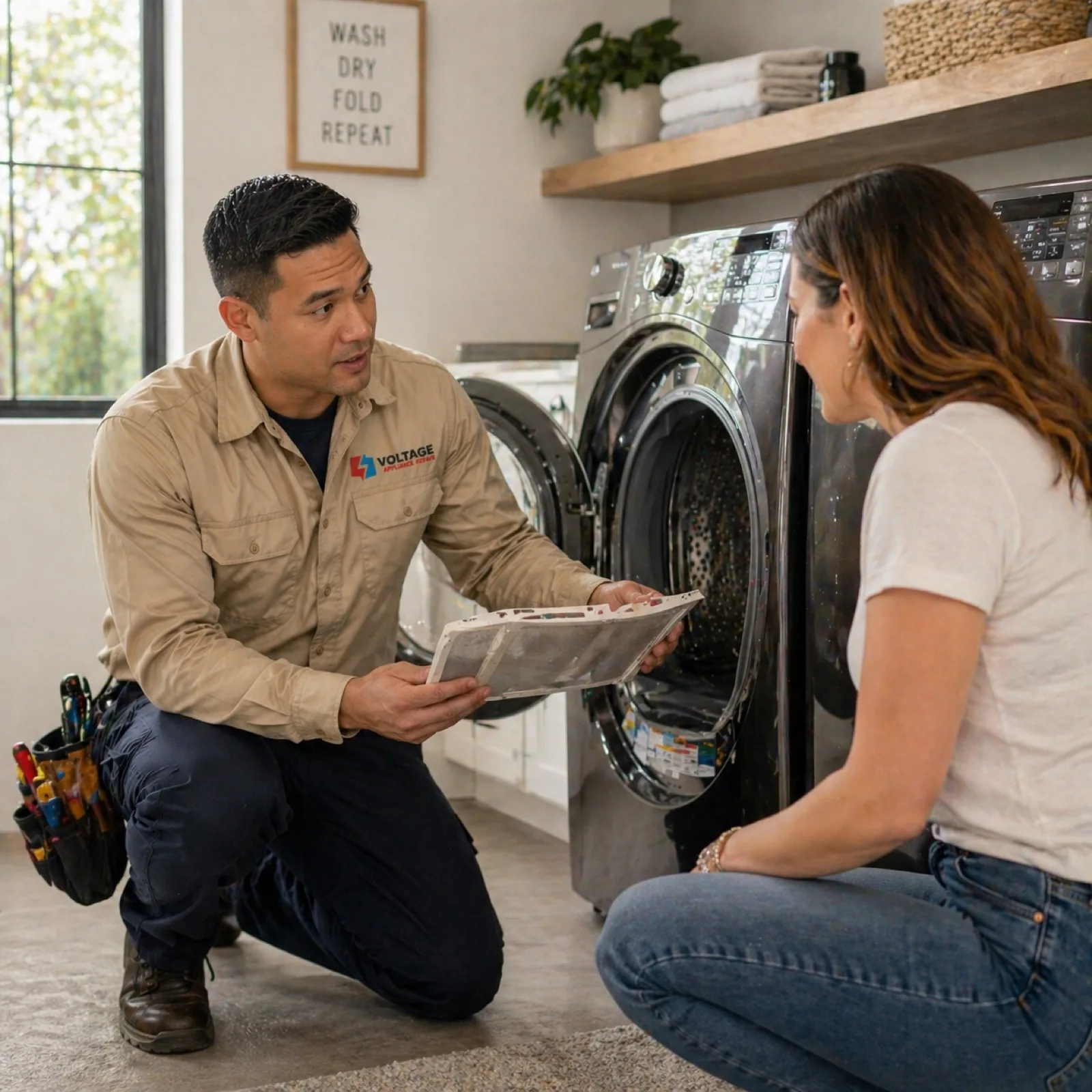
You open the washer and find a drum full of standing water. The cycle stopped. Nothing drained. It's a frustrating sight — but it's rarely random.
Washers don't just "decide" to stop draining. Something specific failed. In most cases, one of four things is responsible. Three of them you can check yourself. One usually needs a tech.
Dealing with this right now? A free service call with your repair gets you an honest answer — fix it or skip it, quoted upfront. Call 786-869-3888 · same-day across Broward & Miami-Dade.
Here's how to work through it.
1. The Coin Trap / Drain Pump Filter (Front-Load Machines)
This is the single most common cause on front-load washers. And most homeowners don't know it exists.
Every front-load washer has a small filter — sometimes called a coin trap — positioned near the bottom front of the machine, behind a small access panel. It catches lint, coins, hair ties, and anything else that escapes the drum. Over time, it fills up. When it's fully clogged, water has nowhere to go.
The fix is straightforward: open the panel, place a towel and a shallow dish under it, unscrew the cap slowly, let the water drain out, and pull the filter free. Clean it under a faucet. Reinstall.
Do this every 3–4 months. Most people do it never. That's why this is step one.
Owner-fixable? Yes — in most cases, 15 minutes.
2. The Drain Hose
The drain hose runs from the back of your washer to the standpipe or utility sink. It can fail in two ways.
The first is a kink. If the machine was recently moved, pushed back against a wall, or jostled, the hose may have bent sharply enough to block flow. Pull the machine out and look. A sharp curve near where the hose connects to the wall is all it takes.
The second is a clog inside the hose. This is less common but happens — especially if lint bypassed the filter for years. Disconnect the hose, hold it over a bucket, and run water through it from a separate faucet. If it's restricted, clean it out or replace it.
Owner-fixable? Yes, usually. A new drain hose costs a few dollars at any hardware store.
3. The Lid Switch (Top-Load Machines)
Top-load washers won't spin or drain if the lid switch fails. The machine thinks the lid is open, so it stays locked in standby. Water sits.
You'll often hear a click when you press the lid down — that's the switch engaging. No click, or a click with no response, points here.
Some homeowners can test and replace a lid switch with a multimeter and a tutorial. Others shouldn't. If you're comfortable with basic appliance disassembly, it's a $10–$20 part. If not, call a tech — a failed switch is a one-visit fix.
Owner-fixable? Sometimes. Depends on your comfort level.
4. The Drain Pump Itself
If you've checked the filter, hose, and lid switch and the drum is still full — the pump is the likely culprit.
Drain pumps fail two ways: mechanically (the impeller cracks or seizes) or electrically (the motor burns out). A dead pump makes one of two sounds: nothing at all, or a humming noise with no water movement. That hum means the motor is trying and can't turn — usually a seized impeller or a foreign object jammed inside.
Replacing a drain pump means partial disassembly of the machine. It's not a dangerous repair, but it does require the right part, proper diagnosis, and correct reassembly. Do it wrong and you'll have a leak.
Owner-fixable? Rarely. This is where a tech pays for themselves.
Honest Breakdown: When to DIY, When to Call
Most drain problems fall into one of two camps.
DIY-able (about 60% of cases): Clogged coin trap, kinked hose, minor debris in the drain hose. Find the blockage, clear it, and the machine drains normally. Done.
Tech territory: Dead drain pump, failed lid switch you can't access, internal hose damage, or anything where you're still unsure of the cause after checking the basics. Guessing your way through pump replacement costs more time — and sometimes more parts — than one diagnostic visit.
The filter check takes 15 minutes. Start there. Work through each step in order. If you're still staring at standing water after that, the pump is almost certainly involved.
We carry drain pumps for most major brands on the truck. One visit, most of the time.